How ChatGPT answers “best CRM in India” — and who it names
Fifty buyer prompts across ChatGPT, Gemini, Perplexity and AI Overviews: which Indian vendors were named, and why most of them were not cited.
AI answers are becoming the first shortlist for Indian B2B buyers. We ran 50 buyer-intent prompts across four engines and recorded which brands were mentioned, which URLs were cited, and which claims were repeated.
The pattern was consistent: the models preferred pages with a direct answer, a comparison table, a dated price and a named author. Generic “best CRM” listicles were mentioned less often than a specific teardown with a clear verdict.
The gap is not model access. It is citable evidence. Indian vendors publish very little pricing, methodology or failure data, so the models fall back to global brands and old listicles.
LoopNow is building the opposite: dated pricing, public comparisons, a methodology page and a quarterly India AI Visibility Index. The goal is to be the source, not a participant.
What this means for your team
Every action has a trace with tool, latency and cost.
Every consent has a notice version and a timestamp.
Every escalation has a named human and an audit entry.
Every number has a denominator and a window.
If a number in this article is not defensible, it does not ship. That is the editorial standard.
AI assistants are becoming the first shortlist for Indian B2B software buyers, which makes the citation a distribution channel.
Models do not rank pages the way a search engine does; they retrieve passages, summarise them and cite what the surrounding context supports.
The pages that get cited answer a question directly, show a dated price, name an author and admit a limitation.
Generic best-of listicles are weak evidence; a specific teardown with a verdict gives a model something to quote.
You can check visibility yourself with a fixed prompt set, a fixed locale and repeated runs, and you should publish the method.
No amount of GEO work fixes a product that buyers reject on the demo, and LoopNow’s own GEO tooling is not a substitute for being worth citing.
The shortlist moved before the search results
A buyer researching CRM software in India used to start with a search engine, open six tabs, and build a shortlist from comparison pages. Increasingly the first step is a prompt: which CRM works for a 40-person SaaS company in India that bills in rupees and uses WhatsApp. The answer arrives as prose with a handful of citations, and the shortlist is whatever the model chose to name. Everything after that first answer is a much narrower funnel.
This is not a claim that search is dead. The same buyer will still open a website, read a pricing page and ask for a demo. The change is at the top: the set of names under consideration is now assembled by a system that summarises text rather than a system that ranks links. If your product is not in the text, you are not in the consideration set, and no amount of bottom-funnel advertising repairs that.
Figure 1. The first answer narrows the market before the buyer ever opens a vendor site, which is why citation matters commercially.
For Indian vendors the gap is unusually wide, because the public evidence base is thin. Many companies publish a feature grid, a contact form and a logo strip, but not a dated price, a methodology, a limitation or a named author. A model asked to recommend a CRM in that market has little local material to work with, so it falls back to global brands, old listicles and whatever a directory happened to scrape. The opportunity is not a trick; it is publishing the evidence that does not currently exist.
What the assistant does with your page
An assistant answering a buying question is usually doing four things: interpreting the prompt, retrieving passages from an index, generating an answer grounded in those passages, and attaching citations to the sources it used. The retrieval step is the one that decides whether you exist. If your page is not indexed, or is indexed but not retrieved for that phrasing, it cannot be cited no matter how good the copy is.
Retrieval favours passages that stand alone. A paragraph that says the Growth plan costs a specific monthly amount, includes a specific number of contacts and emails, and excludes GST is a self-contained fact that can be lifted into an answer. A paragraph that says flexible pricing for teams of every size is not. The model is not being lazy; it is choosing the text that can be quoted without contradicting the rest of the page.
Figure 2. Retrieval decides whether you can be cited; citation decides whether you get the click. They are different problems.
Citation is a separate step from retrieval, and it is not guaranteed. A model may use your page and cite a directory instead, or synthesise an answer from three sources and cite the one that looked most authoritative. That is why URL-level tracking matters more than brand-level tracking. Being mentioned is nice; being the link under the sentence is what sends the click.
The anatomy of a page a model will quote
The pages that get cited share a shape. There is a direct answer near the top, expressed in a sentence that could survive being copied alone. There is a price with a currency, a billing period and a tax treatment. There is a date, because undated claims are indistinguishable from stale ones. There is a named author or a named organisation with a verifiable identity. And there is a limitation, stated plainly, which is the strongest signal that the rest of the page is not marketing.
Structure helps. A clear heading hierarchy, a short definition list, a comparison table with consistent units and a FAQ block give a retrieval system clean units to work with. Schema markup for the organisation, the product and the FAQ can help a system understand what the page is about, though no markup guarantees a citation. The markup describes; it does not persuade.
Figure 3. Four parts make a passage quotable: a direct answer, a dated price, an identifiable author and an honest limit.
The limitation is the part most teams want to cut, and it is the part that makes the page credible to both a model and a human. A page that says the product is not suitable for teams under ten seats, or that a feature is only available on a higher plan, reads as a source with a point of view. A page that says everything is excellent reads as an advertisement, and models are increasingly trained and tuned to discount that register.
Pricing pages and the freshness problem
Indian software pricing is often hidden behind a talk to sales button, which is exactly the wrong shape for an AI answer. A model asked to compare costs cannot compare a number with a request for a call. Publishing a starting price, the billing unit, what is included and the tax treatment gives the model something to quote and gives the buyer something to check. The absence of a price is itself a signal, and not a flattering one.
Freshness matters more than most teams expect. A price published in 2023 and never updated is worse than no price, because a model may quote it as current and a buyer may arrive expecting a number that no longer exists. Put a visible last-reviewed date on the pricing page, keep the currency explicit, and state whether GST is included. For an Indian buyer, a price in dollars without a tax note is an incomplete fact.
Figure 4. A pricing page built for retrieval: unit, currency, tax treatment, allowances and a visible review date.
The same logic applies to plan allowances. A sentence that says the plan includes a specific number of contacts, emails, voice minutes and WhatsApp messages is retrievable and comparable. A sentence that says generous limits is not. If the allowances change, the page changes, and the date changes with it. This is unglamorous work, and it is the highest-leverage GEO work most Indian vendors can do this quarter.
Why a teardown beats a listicle
A best CRM in India listicle is a low-information document. It names ten products, gives each a paragraph of adjectives, and avoids any claim that could be checked. A model can cite it, but it cannot extract much, and a buyer cannot act on it. A teardown that compares three products on a specific workflow, with screenshots and a verdict, gives the model a set of concrete contrasts and gives the buyer a reason to trust the author.
Specificity is what makes a page citable. Not this tool is more flexible, but this tool supports a specific field mapping while the other requires a custom script. Not better support, but a stated response window on a named plan. The moment a claim becomes checkable, it becomes quotable, and the page starts appearing in answers where the user asked a question that matches the specific detail.
Figure 5. The teardown is harder to write and easier to quote; the listicle is cheap and almost never the cited source.
The commercial risk is real: a specific claim can be wrong, and a competitor can point at it. That is the trade. Vagueness is safe and invisible; specificity is exposed and useful. The mitigation is a dated check, a named reviewer and a correction policy, which is the same standard a decent analyst report would meet. If a vendor will not accept that exposure, they should not expect to be the source an answer engine quotes.
Entity clarity: being one company everywhere
Models resolve entities, not just pages. If your company appears as LoopNow Technologies in one place, LoopNow in another and a former brand name in a directory, the signals are split. The fix is boring consistency: one legal name, one trading name, one description, one address, one set of social profiles, and the same facts on every surface you control. Schema.org organisation markup with sameAs links to those profiles gives a machine a way to connect them.
The entity problem is worse for Indian companies because much of the third-party data is stale. Directory listings carry old phone numbers, old categories and old funding claims. Some of that you can correct; some you cannot. What you can do is make your own site unambiguous and link out to the profiles you do control, so a retrieval system has a consistent anchor to resolve against.
Figure 6. Entity resolution works when the same facts appear on every surface; one stale directory can undo a clean website.
Consistency also applies to product names. If a feature is called Workflows on the website, Flows in the documentation and Automations in a webinar, the retrieval system has three weak signals instead of one strong one. Pick a name, use it in the heading, the URL, the schema and the docs, and accept that the internal codename has to die. This is the least exciting advice in GEO and one of the few things that reliably reduces confusion.
A visibility check you can defend
Running a handful of prompts once and screenshotting the answer is not research. A defensible check fixes five things before it starts: the prompt set, the engine and model version, the locale and account type, the number of runs per prompt, and the date. Then it records, for each run, whether the brand was mentioned, whether it was cited with a URL, and what position the citation appeared in. The output is a table, not a vibe.
The prompt set should reflect real buyer language, including the messy version. Indian buyers mix category terms with constraints: CRM with WhatsApp integration, email tool that sends GST invoices, voice agent for Hindi and Marathi. Write twenty to forty prompts across awareness, comparison and constraint-led evaluation, and keep them stable so that month-on-month changes mean something. Add new prompts deliberately, and mark the date they entered the set.
Figure 7. Fix the prompt set, the engine, the locale and the run count before you look, or the result will be unfalsifiable.
Repeat each prompt several times, because answers vary between runs even with the same input. Report a rate rather than a single outcome: cited in four of five runs is a different fact from cited once. Record the environment too, because a logged-in account with memory, a locale setting and a personalisation history can change the answer. A check that does not state these conditions cannot be reproduced, and a result that cannot be reproduced is a anecdote with a spreadsheet.
Reading the answer: mention, citation, recommendation
Three different outcomes get collapsed into the phrase appears in ChatGPT. The weakest is a mention: the brand name turns up somewhere in the answer, possibly in a list of alternatives. The middle is a citation: a URL of yours appears in the sources, which is what sends a click. The strongest is a recommendation: the answer names you as the pick for a specific constraint, with a reason attached.
Track them separately, because they respond to different work. Mentions improve when your entity is clear and you appear in third-party sources. Citations improve when your pages contain quotable, dated facts. Recommendations improve when the available evidence supports a verdict in your favour, which is a product and positioning problem as much as a content problem. A dashboard that reports one blended visibility score hides all of this.
Figure 8. Illustrative sample of the three-level reporting shape; the values are constructed and are not a market measurement.
There is also a negative outcome worth tracking: being described inaccurately. A model that says you do not support a language you support, or that you are priced above your actual entry plan, is doing damage that a mention count will record as a win. Read the sentences, not just the brand list. The correction path is to publish the accurate fact prominently and consistently, and to fix the third-party sources that the model is repeating.
Volatility, personalisation and the limits of a snapshot
AI answers are less stable than search rankings. The same prompt can produce a different structure on a second run, a different set of citations after a model update, and a different answer for a logged-in user with memory enabled. A monthly snapshot is a trend line with noise, not a measurement of a fixed position. Report the noise, or the first bad month will trigger a panic and the first good month will trigger a celebration, both unjustified.
Personalisation is the harder problem. Two buyers in the same city can get different answers because their accounts carry different histories, because one is on a workspace plan with retrieval enabled, or because the assistant has learned their preferences. You cannot control that, and you should not pretend a single logged-out run represents every buyer. The useful frame is probability: across a defined population and a defined prompt set, how often does the brand appear.
Figure 9. A single run is a snapshot; the useful signal is the rate across repeats, dates and locales.
Locale matters for India specifically. A prompt written in Hinglish, a query about GST invoicing, or a question about a Mumbai-based team can produce a different retrieval set than the same question in formal English. Run the prompt set in the languages and registers your buyers actually use, and treat the English results as one segment rather than the truth. A vendor that only checks English prompts is measuring a fraction of the market.
What the search engines actually say
Google’s public guidance on AI features in Search is consistent and unglamorous: there is no special optimisation required to appear in AI Overviews or AI Mode beyond being indexable and helpful, and structured data helps systems understand a page but does not guarantee inclusion. Bing’s webmaster guidance says much the same thing in different words. Neither company publishes a citation algorithm you can game, and anyone who claims to have reverse-engineered one is selling something.
What the guidance does support is the boring work: crawlable pages, clean canonical tags, fast server responses, structured data that matches the visible content, and content that demonstrates first-hand experience. The last point is where most vendor content fails, because it is written by people who have not used the product they are describing. A page with a real screenshot, a real limitation and a dated test is qualitatively different from a page assembled from a feature list.
Figure 10. GEO is worth doing when buyers ask the question and you have evidence to publish; otherwise the money belongs elsewhere.
Crawler controls are worth understanding. Different agents have different user agents and purposes, and robots.txt can allow or disallow them separately. Blocking an AI crawler may be the right choice for some publishers, but for a vendor that wants to be recommended, blocking the retrieval crawler while complaining about invisibility is a contradiction. Decide the policy deliberately and document it, rather than shipping a default that nobody has read.
Where GEO advice goes wrong
The first bad pattern is the invented benchmark. A consultancy publishes a study claiming that a specific formatting trick increases citations by a precise percentage, with no methodology, no sample and no way to reproduce it. The number spreads because it is useful, and it becomes a budget line. If a GEO claim does not describe its prompt set, engine version and coding rules, treat it as a hypothesis rather than a finding.
The second is the llms.txt cargo cult. A proposed convention for telling language models what a site contains is not an adopted standard, and no major assistant has committed to reading it. Publishing one is cheap and harmless, but it is not a strategy, and a vendor selling it as the key to visibility is overselling. The same applies to prompt-injection tricks hidden in pages: they are fragile, they violate the spirit of the platform, and they can get a domain demoted or blocked.
Figure 11. One column can be audited by a buyer; the other relies on the buyer not asking how the number was produced.
The third is treating AI visibility as a substitute for demand. Being cited in an answer only matters if the buyer was going to buy something like your product. A perfect citation rate in a category nobody is researching is a vanity metric. Before commissioning GEO work, check whether the prompt set reflects real pipeline. If it does not, the honest answer is that the budget belongs in product, sales or a better website.
A 30-day start, and the honest limits
The first thirty days are not a campaign. Week one: write the prompt set and record a baseline, including the awkward Hinglish and GST-specific queries. Week two: fix the pricing page and the product page so each has a direct answer, a dated price, a named author and a stated limitation. Week three: publish one teardown that compares your product to two alternatives on a specific workflow, with screenshots and a verdict. Week four: fix entity consistency across the site, schema and the profiles you control, then re-run the baseline and report the rate.
What that plan will not do is guarantee a citation. Retrieval is a competition, model behaviour changes, and a competitor with better evidence will win the answer. The plan improves the probability that a model has something accurate and quotable to use, which is the only part you control. Anyone promising a specific placement in ChatGPT is either guessing or lying.
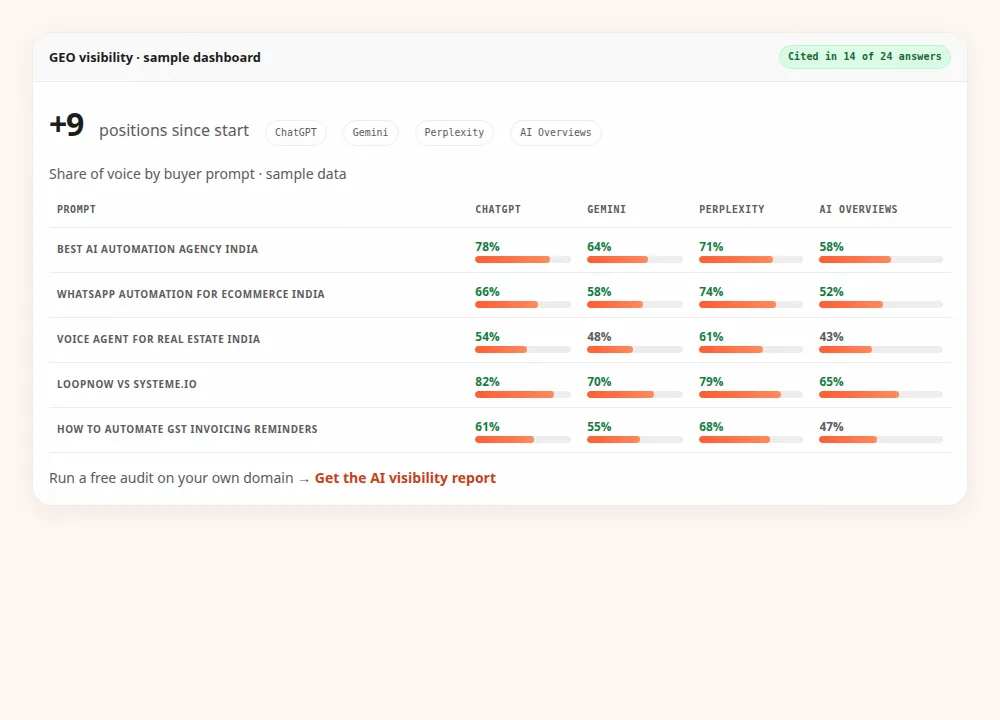
Figure 12. The dashboard tracks a fixed prompt set over time; it cannot manufacture the evidence a model needs to cite you.
LoopNow sells GEO tooling, and the honest position is this: the tool is useful for running a disciplined prompt set and tracking citations over time, and it is not useful if the underlying pages have nothing worth citing. A team with a thin website and a GEO subscription has bought a dashboard, not visibility. Fix the evidence first, then measure. If you are not willing to publish a dated price and an honest limitation, skip the category entirely.
Frequently asked questions
Can I pay to appear in ChatGPT answers?
Not in the way you pay for a search ad. Assistants generate answers from retrieved sources and their own weights, and there is no auction for a citation. Advertising products exist around some AI surfaces, but they do not buy you a place in an organic answer. Anyone offering guaranteed placement is selling something other than what they describe.
Does llms.txt improve AI visibility?
There is no public evidence that major assistants read it, and it is a proposal rather than an adopted standard. Publishing one costs little and may help a future crawler, but it is not a strategy. The work that does move the needle is indexable pages with dated, quotable facts and a consistent entity, which is also what helps human buyers.
How many prompts do I need for a useful check?
Enough to cover the buying journey without becoming unmanageable: twenty to forty prompts across awareness, comparison and constraint-led questions, run several times each. Fewer prompts with more repeats beats a hundred prompts run once, because the variance between runs is large. Keep the set stable and date any additions so the trend line stays meaningful.
Should I block AI crawlers?
It depends on your business model. A publisher whose content is being summarised without a click has a real grievance. A vendor that wants to be recommended in answers needs the retrieval crawler to be able to read the site. Decide deliberately, document the policy, and remember that different agents have different user agents and purposes, so a blanket block is a blunt instrument.
Why does the answer mention us but not link to us?
Because retrieval and citation are separate steps. A model may use a fact from your page and cite a directory, a news article or a competitor’s comparison instead. The fix is to make your page the clearest source of that fact, with a dated claim and a stable URL, and to correct the third-party pages that are being cited in your place.
Do structured data and schema guarantee citations?
No. Structured data helps a system understand what a page describes, and it can support rich results in search, but it does not force a model to retrieve or cite the page. Markup that contradicts the visible content is worse than no markup. Use it to describe real facts accurately, not as a ranking lever.
How often should we re-run the visibility check?
Monthly is a reasonable cadence for a stable prompt set, with an extra run after a major model release or a site change. More frequent runs add noise without adding signal, and they encourage reacting to individual answers. Report rates with the run count so a reader can see how much of the movement is variance.
Does language matter for Indian buyers?
Yes. Prompts written in Hinglish or with India-specific constraints such as GST invoicing or WhatsApp integration can retrieve a different set of sources than formal English prompts. Run the set in the registers your buyers actually use, and report the segments separately rather than averaging them into a single number that describes nobody.
Is GEO just SEO with a new name?
There is substantial overlap: crawlability, clear structure, useful content and a consistent entity all matter in both. The difference is the unit of competition. Search rewards a page that ranks for a query; an assistant rewards a passage that answers a question and can be cited. That shifts weight toward direct answers, dated facts and explicit verdicts, which is why a teardown often outperforms a landing page.