Per-message billing replaced conversations. Here is the unit economics of a utility template against a marketing blast for an Indian D2C brand.
Meta now bills WhatsApp by delivered message, not by a 24-hour conversation. That changes the maths for every Indian brand running broadcasts, utility updates and AI replies.
Marketing messages cost more than utility or service. The cheap strategy is not “send fewer messages”; it is “send the right message, on the right template, with a clear opt-out.” A utility message that resolves a delivery issue costs a fraction of a broad marketing blast.
Model three numbers before you launch: messages per order, resolution rate without a human, and opt-out rate. If the agent resolves 60% of threads and the utility template stays under the Meta rate, the channel pays for itself. If it does not, fix the template and the targeting before adding volume.
LoopNow passes Meta rates through, shows the per-message cost in the console, and applies a spend cap. The price should never be a surprise at the end of the month.
What this means for your team
Every action has a trace with tool, latency and cost.
Every consent has a notice version and a timestamp.
Every escalation has a named human and an audit entry.
Every number has a denominator and a window.
If a number in this article is not defensible, it does not ship. That is the editorial standard.
As of 4 November 2026, LoopNow bills WhatsApp per delivered message: ₹1.15 for marketing and ₹0.22 for utility or authentication, with Meta’s category cost included.
Plans include 250 messages on Free, 1,000 on Starter, 5,000 on Growth and 20,000 on Scale; Enterprise is custom from ₹75,000 a month.
Overage is billed at the same published rates, the spend cap is on by default, and every price is in INR and excludes 18% GST.
Meta bills per delivered message by category — marketing, utility, authentication and service — and not as a flat per-conversation fee. Marketing, utility and authentication are priced per message; service is the reply inside the 24-hour window and carries no per-message charge.
A sample month of 60,000 marketing and 20,000 utility messages on Scale comes to ₹88,970.82 including GST, with the arithmetic shown section by section.
The invoice is predictable only if the category is right, because ₹1.15 and ₹0.22 are more than five times apart.
The unit changed, and the unit is the story
For years, WhatsApp billing was described in conversations. A twenty-four-hour window opened, the messages inside it were bundled, and the invoice counted windows. Meta now bills delivered template messages one by one, by category, and the shape of the cost model changed with it. A broadcast to ten thousand people is ten thousand billable events, not one campaign with a single line on the invoice. A vendor still quoting you a flat per-conversation fee is quoting a bundle, and the bundle is where the unit price hides.
The change matters because it moves cost closer to behaviour. A team that sends three reminders instead of one now pays three times for the same customer, and a team that segments properly pays only for the people it actually needs to reach. The unit is also a design constraint: every extra template in a journey has a price, so the journey should earn its length.
Figure 1. The billable path for one message. The category is decided at template approval, long before the send, and it decides whether the message costs ₹1.15 or ₹0.22.
The numbers are not a secret, and this article uses the ones LoopNow publishes. A delivered marketing message costs ₹1.15 and a delivered utility or authentication message costs ₹0.22, both inclusive of Meta’s category cost. Plans include 250 messages on Free, 1,000 on Starter, 5,000 on Growth and 20,000 on Scale, with Enterprise custom from ₹75,000 a month. Overage is billed at the published rate, the spend cap is on by default, and every figure is in INR and excludes 18% GST.
One caveat, and it is the only one in this article. Those are the rates and allowances published on 4 November 2026. Meta sets its own card for each market and revises it, so the underlying cost can move without this page changing. Verify the current rate card for India before you sign an annual volume forecast, and ask which date a quoted rate describes.
Marketing message: ₹1.15 per delivered message.
Utility message: ₹0.22 per delivered message.
Authentication message: ₹0.22 per delivered message, the same rate as utility.
Service message: a free-form reply inside the 24-hour window, with no per-message charge.
Four categories, four economics
Marketing covers promotions, offers, product launches and re-engagement. It is the category most likely to be ignored, reported or blocked, and it is the one priced highest at ₹1.15 a message. Utility covers a transaction the customer already has with you: an order confirmation, a delivery update, a payment reminder, an appointment change, at ₹0.22. Authentication covers one-time codes and login verification, at the same ₹0.22. Service covers the replies a business sends inside a customer-initiated conversation, and it is not billed per message at all.
The categories are not just price bands. They carry different consent expectations, different template rules and different quality signals. A promotional message miscategorised as utility may be approved once and then rejected or reclassified, and the correction arrives after the campaign has run. The category is a statement about why you are messaging, so it should match the content, not the budget.
Figure 2. Marketing and utility are the two categories most Indian teams use. The rate gap is more than five to one, and the difference is intent rather than tone.
Service is the category that behaves least like a template. When a customer messages you, a twenty-four-hour window opens and the reply is free-form, which is how a support thread stays conversational and how it stays cheap. Outside that window the same intent needs an approved template, and the template is billed at the rate for its category. Build for the current rule rather than a remembered one: free-form inside the window, template outside it, and the invoice follows.
What actually triggers a charge
Three conditions have to line up: the message is delivered, the category is billable, and the conversation is in a state where a charge applies. A message that fails to deliver is not a delivered message, which is why delivery reports and billing reports should reconcile. A template that is rejected never sends, so it never bills. At ₹1.15, a campaign to 10,000 people is ₹11,500 before tax and ₹13,570 with GST, so a duplicated send or a retry loop is not a rounding error.
The most common surprise is the conversation state. When a customer messages you, a twenty-four-hour service window opens. Inside that window you can reply with free-form messages, which is how a support conversation feels natural and why it carries no per-message charge. Outside it, you need an approved template to start a new conversation, even if the customer asked you a question yesterday. The window is a rule, not a suggestion, and it resets with each new customer message.
Figure 3. The first question before any WhatsApp send. The branch decides whether a template, and therefore a per-message charge, applies at all.
The second surprise is the template itself. A message that looks like a reminder may be classed as marketing if it contains an offer, a discount or a link to a promotion. A utility template that adds a promotional line at the end can be reclassified, and the reclassification can apply to future sends. Write the template for the category you intend, and keep the promotional content in a marketing template where it belongs and where you have budgeted ₹1.15 for it.
The 24-hour window and the free-form trap
The service window is generous and easy to misuse. A customer asks about an order at 10 a.m., the agent replies at 10:05, and the window stays open for a day. That is the right model for support, and it is the cheapest part of the channel because the reply carries no per-message charge. It becomes a trap when a marketing team uses the open window to send a promotion as a free-form message. The customer did not consent to marketing, the message may be reported, and the ₹1.15 saved is not worth the quality rating.
The window also creates a timing problem for automation. A workflow that waits two days before following up will find the window closed and need a template. A workflow that follows up within the window can reply naturally. Design the timing around the window rather than discovering it when the send fails. For appointment reminders and delivery updates, the template is usually the right tool anyway, because it is predictable, auditable and costs a known ₹0.22.
Figure 4. One conversation across a day. Inside the window the reply is free-form and unbilled per message; after it, a utility template costs ₹0.22.
Consent sits above all of this. A customer who messages you about an order has consented to a service conversation, not to a year of offers. Keep marketing consent separate, record when it was given, and give a working opt-out in every marketing template. Under DPDP, the record of that consent is evidence you may need to produce, and the WhatsApp opt-out is one of the places it is withdrawn. Consent is also the cheapest cost control on the page, because a list that opted in does not get reported.
Why the same template costs different amounts abroad
WhatsApp is a global product with local pricing. Meta publishes rates by market, and the rate for a marketing message in India is not the rate in Brazil, Indonesia, the United Arab Emirates or the United Kingdom. The differences reflect local telecom economics, competition and the value of the channel in that market. A campaign that is affordable in one country can be expensive in another with the same creative and the same audience size.
LoopNow publishes the India rate only: ₹1.15 for marketing and ₹0.22 for utility or authentication. For a send to another market, the rate is set by Meta for that market, and we quote it in writing for your volume. Putting a number for Brazil or the UAE in this article would be guessing at a card we do not set, and a guess that is close enough to look authoritative is worse than no number at all.
Figure 5. Six markets, six rate cards. India is the column with published numbers here; the other five follow Meta’s card for that market and are quoted per account.
Tax adds another layer. The platform fee and the message charges both sit on an Indian invoice at 18% GST, so a Scale month with no overage becomes ₹29,498.82 rather than ₹24,999. Ask for a sample invoice with the tax lines shown, not just a price list. A registered business can usually claim input credit on the GST charged, which changes the effective cost, but the credit depends on the invoice being raised correctly. Compare the total with tax, not the headline rate.
Template approval, quality and the cost of a rejection
A rejected template has no per-message cost and a real operational cost. The campaign slips, the team rewrites, the reviewer sees the same account again, and the launch window closes. A reminder that misses its date still has to be sent once it is approved, so the ₹0.22 is paid late and lands on a customer who has already acted. Repeated rejections also affect the quality signal attached to the number, which influences how the platform treats your traffic.
Approval is mostly about clarity. State the purpose, use the right category, provide plausible sample values for every variable, and avoid content that looks like something else. A utility template with a discount code reads as marketing, and at five times the rate it is an expensive way to be rejected. A marketing template without an opt-out path reads as a complaint waiting to happen. Keep the language plain, keep the variable count low, and test the rendered message before submitting.
Figure 6. The template lifecycle. The rejection branch costs no message fee and a week of campaign time; the paused branch costs revenue.
Quality is a longer game. Blocks, reports and low read rates push the quality rating down, and a low rating can pause templates or limit your sending. The causes are usually audience and frequency, not copy: messaging people who never opted in, sending too often, or using the channel for things the customer did not expect. Segment, cap frequency and remove people who never engage. That is cheaper than any rate negotiation, because the rate is published and the quality rating is not for sale.
Authentication messages and OTP economics
Authentication templates deliver one-time codes, login approvals and account verification. They are short, time-sensitive and priced at ₹0.22, the same as utility, which makes them attractive to optimise. They are also the category most exposed to fraud. An OTP that can be triggered repeatedly at someone else’s number is a way to burn credit and harass a stranger, and the cost lands on your account: 100,000 codes is ₹22,000 before tax and ₹25,960 with GST, which is exactly the sort of line an attacker would like to run for you.
The controls are product controls, not billing controls. Rate-limit OTP requests per number and per device, require a second factor before resending, expire codes quickly, and monitor for a spike in requests to a single prefix. Use a button that copies the code rather than asking the customer to retype it, and keep the template text short enough that it renders on a lock screen. Authentication is a security surface with a price tag, and the price is linear in abuse.
Figure 7. The authentication path with the control points that decide both cost and fraud exposure. Every unchecked retry is another ₹0.22.
Do not assume authentication is always the cheapest route for a verification flow. If the customer is already in a service conversation, a free-form reply may be the right way to confirm something, and inside the window it carries no per-message charge, as long as it is not a secret code. The category should follow the purpose and the security requirement, not a hunt for the lowest rate. Getting this wrong is how a verification flow becomes a fraud vector.
A worked month: 80,000 messages on the Scale plan
Take a business on Scale, which costs ₹24,999 a month and includes 20,000 WhatsApp messages. In the month it delivers 60,000 marketing messages and 20,000 utility messages, so 80,000 delivered messages in total. This is a sample calculation built from the published rates, not a quotation, and it assumes every message is delivered and correctly categorised.
The allowance is a single pool of 20,000 messages, not a separate bucket for each category, so the order in which it is applied changes the bill. Apply it to the marketing messages first, which is the reading that saves the customer the most: 60,000 minus 20,000 leaves 40,000 billable marketing messages, and all 20,000 utility messages remain billable. Note the order your own invoice uses, because the difference is material and it is shown below.
Figure 8. Sample calculation, in INR: the three pre-tax lines for 60,000 marketing and 20,000 utility messages on Scale. They add to ₹75,399 before GST; the invoice is ₹88,970.82.
Marketing overage is 40,000 multiplied by ₹1.15, which is ₹46,000. Utility is 20,000 multiplied by ₹0.22, which is ₹4,400. Overage totals ₹50,400. Add the plan fee of ₹24,999 and the pre-tax subtotal is ₹75,399. GST at 18% is ₹13,571.82, and the invoice total is ₹88,970.82 for the month.
Two sensitivities are worth running before you sign. If the invoice applies the allowance to utility messages first, utility overage disappears, marketing overage becomes 60,000 at ₹1.15 or ₹69,000, the subtotal is ₹93,999 and the total with GST is ₹1,10,918.82. And at the same volume, Growth at ₹7,999 with 5,000 included comes to ₹89,265.82, which is ₹295 more than Scale. At 80,000 messages the plan tier matters far less than the category mix, which is the number to attack first.
Plan allowances, plan fees and the spend cap
Every plan carries a WhatsApp allowance, and the allowance is the number that decides whether the month is quiet or expensive. Free includes 250 messages at no monthly fee. Starter is ₹2,999 a month, or ₹2,399 on annual billing, with 1,000 messages. Growth is ₹7,999, or ₹6,399 annual, with 5,000 messages. Scale is ₹24,999, or ₹19,999 annual, with 20,000 messages. Enterprise is custom volume from ₹75,000 a month, with a named CSM and a private VPC. All of these exclude 18% GST, and every payment produces a GSTIN invoice.
Past the allowance, the published per-message rate applies with no step-up and no separate Meta invoice. That is the part worth checking in a contract: a bundled rate of ₹1.15 and ₹0.22 is easy to budget and needs no reconciliation against a second currency, while a pass-through arrangement is more transparent and moves the moment Meta moves. Neither is dishonest, but you should know which one you bought before the first big campaign.
Figure 9. Included WhatsApp messages a month by plan, from the published pricing page. Overage beyond the allowance is billed at ₹1.15 or ₹0.22 depending on category.
The spend cap is the control that makes the model safe. It is on by default, with a choice between auto top-up and a hard stop. A hard stop protects the budget and can interrupt a legitimate support conversation at the worst moment. Auto top-up protects the conversation and can produce a bill you did not expect. Pick the failure you can live with, set the threshold, and alert at seventy per cent rather than at a hundred, because an alert at the cap is a post-mortem.
Free: ₹0 a month, 250 WhatsApp messages, 1,000 marketing contacts.
Starter: ₹2,999 a month, 1,000 messages, ₹2,399 on annual billing.
Growth: ₹7,999 a month, 5,000 messages, ₹6,399 on annual billing.
Scale: ₹24,999 a month, 20,000 messages, ₹19,999 on annual billing.
Enterprise: from ₹75,000 a month, custom message volume and a named CSM.
Reducing the bill without harming the customer
The biggest saving is not a rate negotiation. It is sending fewer messages that do not need to exist. A reminder that duplicates an email, a promotion to a segment that never opens, a follow-up that arrives after the customer has already paid: each one is a cost with no return. Removing a single redundant marketing reminder to 20,000 contacts saves ₹23,000 before tax and ₹27,140 with GST, which is more than most teams ever recover from a discount conversation.
The second saving is category discipline. A transactional update sent as marketing costs ₹1.15 instead of ₹0.22, more than five times as much, and it performs worse because the customer did not ask for an offer. A promotional line inside a utility template risks reclassification of the whole template. Put the content in the right category and the rate follows. The third is timing: a message inside the service window can be a free-form reply with no message charge, while the same message an hour later needs a template.
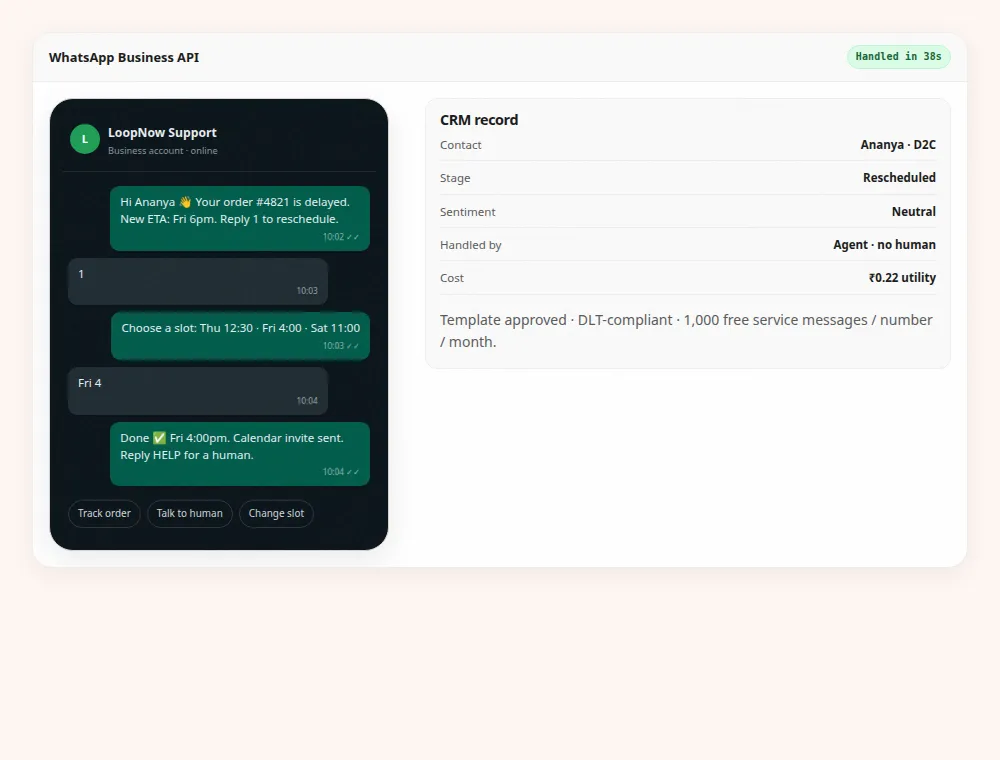
Figure 10. The WhatsApp workspace with a sample conversation, its category and the cost shown per message. Sample run, not customer data.
The fourth is opt-out hygiene. People who block or report you are not just a quality problem; they are a signal that the list is wrong. Remove them, suppress them across channels, and stop paying ₹1.15 to reach people who do not want to hear from you. A smaller engaged list is cheaper per resolved conversation than a large list with a rising block rate, and it protects the number for the customers who do want to hear from you.
Reading the invoice line by line
A WhatsApp invoice should separate the platform fee from the message charges, show the count per category, and show the tax. On the sample month above that means the ₹24,999 plan fee, 40,000 marketing messages at ₹1.15, 20,000 utility messages at ₹0.22, and a GST line. If everything arrives as one line called messaging, you cannot reconcile it against your own logs, and you cannot tell whether the increase came from volume, category mix or a rate change.
Reconcile the counts monthly. Export delivered messages by category from your own system, compare with the invoice, and investigate differences above a tolerance you set. The usual causes are retries, messages delivered after the reporting cut-off, and templates that were reclassified from utility to marketing after approval. A reconciliation habit catches a billing error early and, more often, catches a workflow that is sending more than the team thinks.
Figure 11. The four lines that make a WhatsApp invoice auditable. A single messaging line cannot be reconciled against your own delivery logs.
Finally, check the tax and the currency. An Indian invoice should show GST separately, and the rate should match what you were quoted: ₹7,999 becomes ₹1,439.82 of GST and ₹9,438.82 payable, and a registered business can claim input credit where the rules allow. If a vendor bills in USD, the exchange rate and the card markup are part of your cost. Compare the total cost of ownership at your own category mix, not the headline rate per message.
Questions to ask any provider before you sign
The answers to these questions decide whether the price on the page is the price you pay. Ask for a sample invoice with a month of realistic volume, not a quotation for an average customer, and ask them to show the marketing count, the utility count, the plan fee and the GST as separate lines. Ask whether the ₹1.15 or ₹0.22 already includes Meta’s category charge, and get the answer in writing.
Ask about the spend cap, the alert thresholds and what happens to a support conversation when the cap is hit. Ask how the provider reports delivered messages by category, and whether you can export the data. Ask whether the plan allowance offsets marketing or utility messages first, because at 20,000 included messages that order was worth ₹21,948 in the worked example above. These are operational questions, and they separate a reseller from a platform with a support model.
Figure 12. Six questions for the procurement conversation. The second one is the cheapest to ask and the most expensive to skip.
Then run a small pilot. Send a real campaign to a real segment, reconcile the invoice against your logs, and read the support response time. A pricing model is a hypothesis until a month of your own traffic tests it, and the arithmetic is cheap to check: messages by category, times the published rate, plus the plan fee, plus 18% GST. The provider that helps you check it is the one worth a second month.
Does the published per-message rate include Meta’s category charge?
Does the plan allowance offset marketing or utility messages first?
Can I see delivered counts by category, exportable?
Where is the spend cap, and what does it stop?
Is GST shown separately, and is the invoice GSTIN-compliant?
Who helps when a template is rejected or a number is paused?
Frequently asked questions
How much does a WhatsApp message cost in India?
On LoopNow, ₹1.15 per delivered marketing message and ₹0.22 per delivered utility or authentication message, both inclusive of Meta’s category cost, as published on 4 November 2026. Service replies inside the 24-hour window carry no per-message charge. Plans include 250 to 20,000 messages, overage is billed at those rates, and all prices exclude 18% GST, so 10,000 marketing messages cost ₹11,500 before tax and ₹13,570 with it.
What is the difference between marketing and utility messages?
Utility messages are tied to a transaction the customer already has with you: an order update, a payment reminder, a delivery change, at ₹0.22 each. Marketing messages promote something and cost ₹1.15 each. The category also decides the template rules and the consent expectation. A utility template with a promotional line can be reclassified as marketing, so keep the content aligned with the purpose you declared at approval.
What is the 24-hour service window?
When a customer messages your business, a 24-hour window opens in which you can reply with free-form messages, and those replies are not billed per message. Outside that window you need an approved template, billed at ₹1.15 for marketing or ₹0.22 for utility or authentication. The window resets with each new customer message, so a reply that lands inside it is both more conversational and cheaper.
Are service conversations free?
The replies you send inside the 24-hour customer service window are free-form and carry no per-message charge on LoopNow. The window opens when the customer messages you and resets with every new message from them. Once it closes, the business can only send an approved template, and that template is billed by category. Service is the cheapest part of the channel, which is why answering quickly is a cost strategy as well as a support one.
Why was my template rejected?
The common reasons are a category mismatch, missing or implausible sample values, promotional content inside a utility template, or a variable that could carry prohibited content. A rejection costs time rather than message fees, and repeated rejections affect how your account is reviewed. Rewrite for the declared purpose, reduce the variable count and resubmit with real samples. A rejected utility template is also a ₹0.22 message you still owe once it is fixed and sent.
How do I stop WhatsApp costs from surprising me?
Turn on the spend cap, set an alert well before the threshold, and reconcile delivered counts against the invoice every month. Model messages by category rather than as one number: 60,000 marketing messages at ₹1.15 is ₹69,000 before tax, while 60,000 utility messages at ₹0.22 is ₹13,200. That single distinction explains most invoice surprises, and the largest savings usually come from removing a redundant reminder rather than from negotiating a rate.
Does LoopNow charge Meta rates on top of the plan?
No. The published ₹1.15 and ₹0.22 include Meta’s category cost, so there is no second Meta invoice in a foreign currency and no pass-through line to reconcile. The plan fee covers the platform, the inbox, the AI replies and the included message allowance; delivered messages beyond the allowance are billed at the same published rate. The console shows the cost of each message as it is sent.
Is GST charged on WhatsApp messages?
Yes, at 18% on the taxable value, shown as a separate line on a GSTIN invoice. A ₹24,999 Scale plan becomes ₹29,498.82 with GST, and a ₹7,999 Growth plan becomes ₹9,438.82. A registered business can usually claim input credit on that GST, which changes the effective cost, so model the total with tax rather than the headline rate and check that the invoice is raised correctly.
Can I send marketing messages to customers who messaged me?
A customer who messages you about an order has consented to a service conversation, not to marketing. Keep marketing consent separate, record when it was given and how, and include a working opt-out in every marketing template. The service window is about timing and message charges, not permission. Sending an offer inside an open window saves ₹1.15 and creates a consent problem, which is a bad trade at any volume.