LoopNow vs AiSensy for WhatsApp automation
AiSensy is a focused WhatsApp marketing platform with a strong SMB motion. LoopNow adds email, voice, workflow, CRM automation and GEO on the same runtime — at the cost of a broader product surface.
One runtime vs point tool
LoopNow bundles email, WhatsApp, voice, workflow and GEO. If you only need one of those, the competitor may be cheaper.
| Criterion | LoopNow | AiSensy |
|---|---|---|
| Included; official API | Core product | |
| Included | Not core | |
| Voice | 14 Indian languages | Limited |
| Workflow | Canvas + human gates | Chatbot flows |
| Billing | INR, GST, UPI | INR, GST |
| Entry price | ₹2,999/mo + GST | Lower WhatsApp-only entry |
Competitor details checked 4 Nov 2026. Prices are exclusive of taxes; convert at ₹88/US$ where relevant.
We are not the right fit for everyone.
- You only need WhatsApp broadcasts and a simple chatbot.
- You want the lowest possible entry price for one channel.
- You do not need voice, email or a consent ledger.
When LoopNow wins
You want one bill for email, WhatsApp, voice, workflow and GEO; Indian-language support; DPDP consent records; and AWS Mumbai residency.
Compare plans
The short version
- AiSensy is a focused WhatsApp marketing platform; LoopNow treats WhatsApp as one channel inside a runtime that also runs email, voice, workflow and GEO.
- AiSensy has the lower WhatsApp-only entry price. LoopNow Starter is ₹2,999/mo plus 18% GST and includes allowances for channels AiSensy does not sell.
- Both bill in INR and both work through the official WhatsApp Business API, so template rules and conversation charges come from Meta either way.
- LoopNow is the better fit when a second channel, Indian-language voice or a consent ledger is already on your roadmap. It is the worse fit if you only ever want broadcasts and a simple bot.
- This page is written by LoopNow. AiSensy details were checked on 4 November 2026 and prices change, so confirm them with the vendor before you sign.
What each product is trying to be
AiSensy is a WhatsApp marketing platform. Its centre of gravity is the broadcast: build a list, get a template approved, send it to a segment, read the delivery report, run a chatbot for the replies. The product is shaped around that loop, and the pricing reflects it, with a WhatsApp-only entry point that is lower than what a multi-channel platform charges. For a business whose entire customer conversation happens in one green app, that focus is a feature rather than a limitation, and it explains why the company has a strong small-business motion in India.
LoopNow is a runtime that happens to include WhatsApp. The same contact record, consent state and workflow engine also drive email, voice calls, CRM updates and GEO tracking, and the agent that answers a WhatsApp message can book a slot, call the customer back in Hindi and write the outcome into a CRM. The product is larger than the job AiSensy does, which is both the argument for it and the reason it costs more at the entry tier. If the extra surface area is not going to be used, you are paying for capacity you will never draw on.
Where the two products genuinely overlap
On a plain broadcast, the two systems behave similarly because the constraints come from Meta rather than from the vendor. Your template goes through the same approval queue, the quality rating is the same rating, and the per-message charge is set by Meta’s own category pricing, which applies whichever platform you send from. Anyone who tells you that switching platforms will fix template rejections is selling you a migration, not a solution. The differences start after the message lands: who owns the reply, how the bot escalates, where the transcript lives and what happens to the contact record afterwards.
That is where the products diverge in daily use. AiSensy organises work around campaigns and chatbot flows, which is a good mental model for a marketing team running offers and a support team answering common questions. LoopNow organises work around a run: a trigger, retrieved context, a decision, tool calls and an outcome written back to a system of record, with a human approval step available at any point. Neither model is wrong. The question is whether your work looks more like a sequence of campaigns or more like a process that has to finish something.
The entry-price gap, and the moment it stops mattering
AiSensy’s WhatsApp-only entry point is lower than LoopNow Starter, and that is the single strongest reason to choose it. If your requirement is one channel, one audience and one monthly broadcast, paying for voice minutes you will not use and email allowances you will not send is straightforwardly bad value. We would rather say that here than let you discover it after a trial. The gap is real, it is material for a small business, and it does not disappear because the more expensive product has more features.
The gap narrows when the second channel arrives, and it usually arrives sooner than the roadmap says. A clinic that starts on WhatsApp appointments adds reminder calls when no-shows cost more than the plan. A D2C brand adds email because the list is already there and WhatsApp templates cost money per message. At that point the comparison is no longer ₹2,999 against a lower number. It is LoopNow against AiSensy plus a calling vendor plus an email vendor plus the hours spent making three consent states agree, and the arithmetic often reverses without anyone changing their opinion about either product.
WhatsApp depth: broadcasts, bots and the inbox
AiSensy has spent its engineering years on one surface, and it shows in the parts of the product a marketer touches every day: campaign setup, audience filters, chatbot branching and the reporting that tells you which template earned a reply. A team that sends three broadcasts a week and maintains a menu-driven bot will find most of what it needs already built, with fewer concepts to learn than a general runtime demands. Depth on one channel is a genuine advantage and we are not going to pretend otherwise.
LoopNow’s WhatsApp surface covers the same fundamentals, including the official API, template management and AI replies, but it is designed to hand work to other parts of the runtime. A reply can create a voice callback, a workflow can wait for a document upload, and a conversation can pause for a human approval before a refund is promised. Where AiSensy gives a marketing team a strong campaign tool, LoopNow gives an operations team a way to finish a process that started in chat. If your WhatsApp usage never leaves marketing, that difference is worth less than the price gap.
Email is absent from one side of the table
The comparison row is blunt: LoopNow includes email, AiSensy does not treat it as core. That single difference decides a surprising number of evaluations, because most Indian businesses already have an email list and a transactional sender, even if neither is well run. Keeping email in the same place as WhatsApp means one suppression list, one consent record and one report, instead of a marketing team that assumes someone else unsubscribed a contact who is still receiving WhatsApp offers.
It also means one invoice. LoopNow Starter includes 25,000 emails a month, Growth includes 1,00,000 and overage is ₹0.03 per delivered email. Those numbers are not the cheapest in the market; a raw relay will always beat a managed platform on unit price. The argument is that the email is already paid for inside a plan you are buying for other reasons, so the marginal cost of moving a campaign across is close to zero. If email is your primary channel and WhatsApp is secondary, the comparison to run is against an email specialist, not against this page.
Voice in Indian languages, and why it changes the bill
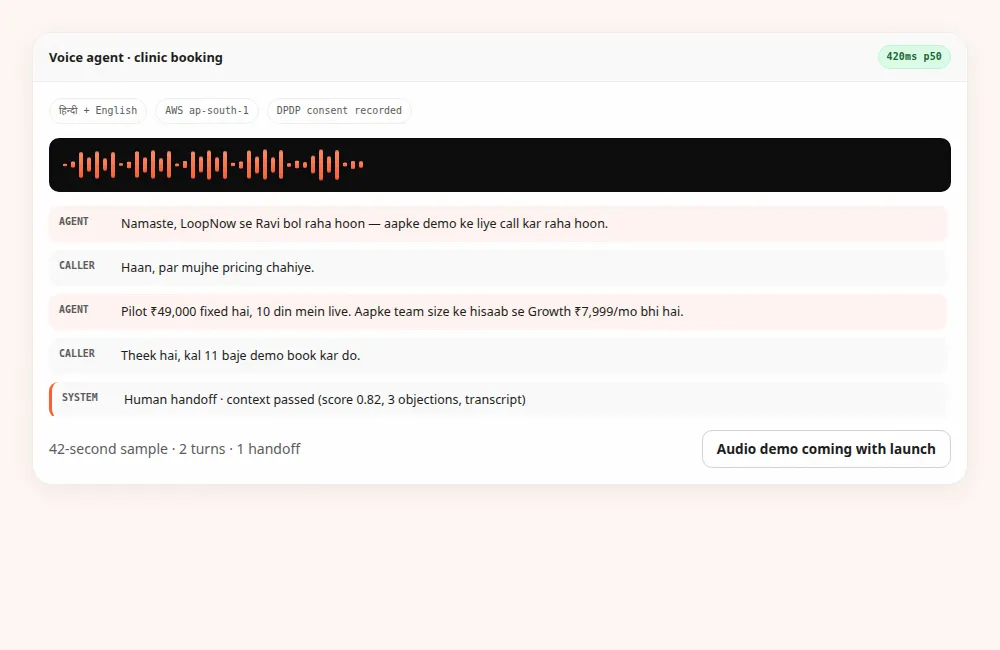
AiSensy’s voice capability is limited according to the rows we checked, while LoopNow runs voice agents in fourteen Indian languages on the same runtime as WhatsApp. The practical example is a customer who replies to a template with a question that needs a conversation: LoopNow can place a call in the language the contact used, confirm the details and write the outcome back to the same record, without a second vendor or a second consent capture. That is a workflow most WhatsApp-only platforms cannot complete without an integration.
It is also the most expensive capability to get wrong. A voice agent that mishears a pincode or talks over a caller is worse than a missed call, and language coverage is not language quality. LoopNow includes 500 voice minutes on Starter, 1,500 on Growth and 6,000 on Scale, with overage at ₹2.20 a connected minute against ₹2.50 pay-as-you-go. Before you count those minutes as a saving, run twenty of your own recorded calls through the agent and listen for the moments a human would have asked a second time.
Chatbot flows against workflow with human approval
A chatbot flow is a tree. The designer draws the branches, the customer walks one of them, and the conversation ends when the tree runs out. That model is easy to explain to a marketing team and cheap to run, which is why it dominates WhatsApp automation. It becomes fragile when the request is not a menu item: a damaged return, a payment that failed twice, a patient asking whether the report is ready. The fallback is usually a human, and the quality of that fallback is where most chatbot projects are judged.
LoopNow’s workflow builder is closer to an operations tool than a menu. Steps can call tools, wait for events, branch on data and pause for human approval, and every run leaves a trace showing what the agent read, which tool it called and why it stopped. That is more machinery than a broadcast team needs. It is the difference between a system that answers questions and a system that finishes a task, and it only matters if your WhatsApp traffic contains tasks worth finishing.
Consent, DPDP and the records nobody asks for until they do
LoopNow keeps a consent ledger per contact and per purpose, with erasure workflows and an exportable audit trail. AiSensy does not list a consent ledger among the rows we checked, which is why our comparison marks the difference rather than claiming the capability is absent. The distinction matters under DPDP: you need to show what a person agreed to, when, on which channel and for which purpose, and you need that record to survive a change of tool. A platform that treats opt-in as a checkbox on a contact is harder to defend than one that treats it as an event.
In practice this becomes a procurement question rather than a marketing one. If you are a hospital, a lender or an insurer, someone will eventually ask for the consent trail behind a campaign, and the answer cannot be a screenshot of a spreadsheet. Ask both vendors for a sample export and read the columns. If the export contains a single opt-in flag with a date and nothing else, you know how much work your legal team will inherit, and you can price that work into the decision instead of discovering it during an audit.
Migration: what moves in two days and what does not
The mechanical part of leaving AiSensy is genuinely quick. Contacts, templates, automations, suppression lists and the WhatsApp Business number can move, and LoopNow quotes about 48 hours for a typical migration done for you. The number is credible because none of that data is exotic: it is CSV, a template library and a number that Meta allows you to migrate between business solution providers. What takes longer is the part nobody lists in a migration scope, which is the institutional knowledge inside the flows your team built over two years.
Those flows encode decisions: what counts as a qualified lead, when to offer a discount, which escalation goes to the owner. Rebuilding them in a different model is design work, not a copy-paste. Budget a week for one person to walk through the old flows with the team that wrote them and write down the rules before anyone opens the new builder. Do that and a two-day migration is realistic. Skip it and you will spend a month discovering, in production, which branch handled the exception.
Lock-in is mostly your templates, not your vendor
WhatsApp has a structural lock-in that neither vendor controls: the number, the template library and the quality rating belong to a business account, and moving between solution providers takes a Meta approval step. That is the same for AiSensy and LoopNow, so it is not a differentiator. What differs is everything around it. A platform that stores workflows as proprietary objects you cannot export holds your process, and a platform that lets you export them as JSON holds it less tightly. Ask for the export before you sign, not after.
LoopNow publishes an exit path: contacts with consent state, conversation history, run traces, workflow and agent definitions as JSON, and the template library. AiSensy’s export surface is not documented in enough detail for us to grade it here, so we mark that as not verified rather than assume the worst. The practical advice is the same for both: run the export on day three of a trial with a small list, read the file, and decide whether you could rebuild from it. If the answer is no, that is a cost of ownership whether or not it appears on the pricing page.
Who should stay on AiSensy
Stay if WhatsApp is the whole plan and the plan is simple. A coaching institute that sends admission reminders, a clinic that confirms appointments, a local retailer that runs a weekly offer to a list of regulars: these are broadcast-shaped businesses, and a focused WhatsApp platform serves them well at a price a broader runtime cannot match. Stay if the team is small and marketing-owned, because the concepts in a single-channel tool are fewer and the training cost is real. Stay if you have already tuned your chatbot and the flows work.
Stay, also, if your only complaint is price. Switching platforms to save a few hundred rupees a month is a bad trade once you count the migration hours, the retraining and the risk of a quiet week during cutover. And stay if nobody in the business has asked for a second channel, a voice call or a consent export in the last year, because those requests are the actual signal that the current tool has become the constraint. A competitor page that cannot tell you when to stay is a brochure.
Who should move, and how to decide in two weeks
Move when the constraint is the shape of the tool rather than its price. The clearest signals are a second channel already running in a separate product, a support queue that ends in a phone call, a compliance request for consent records, and a finance team reconciling three invoices a month. None of those problems is solved by a better broadcast tool, and all of them are solved by putting the channels on one runtime with one contact record. If two or more of those signals are true, the migration is worth the two days.
The test is deliberately small. Load five hundred real contacts with their consent state into LoopNow’s free tier, rebuild one flow, send one campaign and place twenty test calls in the languages your customers use. Watch the transcript quality, the handoff behaviour and the report. Then price the same volume on AiSensy plus whatever the missing channels cost you today, with 18% GST on both sides. If LoopNow is not clearly better after that, keep your current tool and revisit in six months. That is a cheaper outcome than a migration you regret.
Frequently asked questions
Is AiSensy cheaper than LoopNow?
At the WhatsApp-only entry point, yes. Our comparison data records a lower WhatsApp-only entry price for AiSensy, while LoopNow Starter is ₹2,999/mo plus 18% GST. The gap narrows or reverses once you add a second channel, because the LoopNow plan already includes email, voice minutes and workflow. Price both options at your twelve-month volume before deciding.
Can I keep my WhatsApp number if I switch?
Yes, in the normal case. The number belongs to your WhatsApp Business account and moves between solution providers through a Meta approval step. Expect a short window where the number is being migrated. Plan the cutover for a quiet period, keep the old tool active until the new one is verified, and confirm the process in writing with both vendors before you start.
Does LoopNow charge more per WhatsApp message?
LoopNow bills WhatsApp marketing at ₹1.15 per delivered message and utility or authentication at ₹0.22, with 5,000 marketing messages included on Growth. Both platforms work through the official WhatsApp Business API, so Meta’s category charges apply to both; the platform fee, not the message rate, is usually where the two differ.
How long does migration actually take?
LoopNow quotes about 48 hours for contacts, templates, automations, suppression lists and the WhatsApp number, done for you. The realistic end-to-end window for a team with several live flows is closer to a week once you include rewriting the rules and running a parallel test. Budget the design time separately from the data move and the estimate holds.
Does AiSensy have voice agents?
Our checked rows describe AiSensy’s voice capability as limited, and the comparison marks it that way rather than claiming there is none. If voice is central to your plan, ask AiSensy directly what is supported today, in which languages and at what price, and test it with your own recordings. LoopNow runs voice in fourteen Indian languages with minutes included on every paid plan.
What happens to my chatbot flows?
They do not transfer as executable objects. The contacts, templates and suppression lists move cleanly, but a chatbot tree has to be rebuilt as a workflow. Treat that as design work: write down the rules your current flows encode, then rebuild them once in the new builder. Teams that skip the writing step usually discover the missing branch in production rather than in a dry run.
Is LoopNow DPDP compliant?
LoopNow describes itself as DPDP-ready rather than certified. Consent is recorded per contact and per purpose, erasure and retention workflows exist, the audit trail can be exported, and you can review the data processing agreement and sub-processor list. Readiness is something you verify during evaluation, so ask for the data map and a sample consent export before you commit to a paid plan.
Can I run both tools at the same time?
Not on the same WhatsApp number, because only one business solution provider can be connected at a time. You can run them on separate numbers during a pilot, for example a new campaign line, but that splits your audience and your reporting. The cleaner approach is a short parallel test on a small segment, then a single cutover with a rollback plan agreed in advance.
Who should not choose LoopNow?
Anyone whose entire requirement is WhatsApp broadcasts and a menu bot, with no second channel planned and no compliance ask on the horizon. In that case a focused WhatsApp platform is cheaper and simpler, and the extra surface area in LoopNow is dead weight. We would rather you buy the right tool than buy ours for features you will not switch on.