LoopNow vs Interakt for Indian SMBs
Interakt bundles WhatsApp, a sales CRM and AI agents for Indian SMBs. LoopNow bundles WhatsApp, voice, email, workflow and GEO with a DPDP consent ledger.
One runtime vs point tool
LoopNow bundles email, WhatsApp, voice, workflow and GEO. If you only need one of those, the competitor may be cheaper.
| Criterion | LoopNow | Interakt |
|---|---|---|
| Official API + AI | Core product | |
| Sales CRM | CRM automation + connectors | Built-in |
| Voice | 14 Indian languages | MyCallGenie add-on |
| Included | Not core | |
| GEO | Included | Not offered |
| Entry price | ₹2,999/mo + GST | ₹2,499/mo + GST |
Competitor details checked 4 Nov 2026. Prices are exclusive of taxes; convert at ₹88/US$ where relevant.
We are not the right fit for everyone.
- You want an all-in-one WhatsApp + CRM bundle at a low entry price.
- You are Shopify-first and want the Interakt app ecosystem.
- You do not need email, voice or GEO.
When LoopNow wins
You want one bill for email, WhatsApp, voice, workflow and GEO; Indian-language support; DPDP consent records; and AWS Mumbai residency.
Compare plans
The short version
- Interakt bundles WhatsApp with a built-in sales CRM and a Shopify-friendly app ecosystem at ₹2,499/mo plus GST. LoopNow starts at ₹2,999/mo with email, voice, workflow and GEO on the same runtime.
- Interakt’s strongest argument is the bundle: a small seller gets messaging and a sales pipeline in one place at a low entry price.
- LoopNow’s strongest argument is the runtime: WhatsApp, email, voice in fourteen Indian languages, workflow and GEO share one contact and one consent record.
- Interakt’s voice capability is delivered through a separate product, MyCallGenie, according to our checked rows. LoopNow includes voice on every paid plan.
- Written by LoopNow, checked on 4 November 2026. Both vendors sell in rupees with GST, and both change plans, so confirm current terms before you buy.
Two India-first bundles with different centres
Interakt is built around a simple, effective insight: an Indian small business selling on WhatsApp also needs a place to keep the lead. The product pairs a WhatsApp inbox with a sales CRM, adds AI assistance and an app marketplace, and prices the bundle low enough that a growing seller can justify it before hiring a sales operations person. For a Shopify-first business, that combination removes a spreadsheet and a second login, and it is the reason the product has a clear following among Indian SMBs.
LoopNow starts from the other end. The centre is an agent runtime that can decide, act and record an outcome, and WhatsApp, email, voice and GEO are capabilities attached to it. That makes LoopNow broader and heavier at the entry point, with a plan fee that is ₹500 a month higher than Interakt’s published entry. The question is not which product is better in the abstract. It is whether you are buying a place to keep leads, or a system that runs processes across channels.
The five hundred rupees, and what they buy
The published entry prices are close: ₹2,499 a month for Interakt against ₹2,999 for LoopNow Starter, both before 18% GST. A ₹500 gap is not nothing to a small business, and pretending otherwise would be silly. But it is also the smallest number in the evaluation, because the two plans include different things. Interakt’s entry buys a WhatsApp inbox and a sales CRM. LoopNow’s entry buys 5,000 contacts, 25,000 emails, 500 voice minutes, 1,000 WhatsApp messages, 3 agents, 3 workflows and 5 seats.
The useful way to read the gap is per capability. If you would otherwise pay for an email platform and a calling tool, LoopNow’s entry is cheaper than the sum even at the higher headline. If you need neither, Interakt’s entry is cheaper and simpler, and the ₹500 saved is real every month. Write the two stacks on paper, with the tools you would retire, and compare the totals rather than the first line. That exercise takes twenty minutes and settles the price argument more often than any feature table.
Built-in CRM against CRM automation
Interakt’s built-in sales CRM is the reason many teams choose it, and the reason is straightforward: a WhatsApp lead has somewhere to land. Pipeline stages, follow-up reminders and a contact history inside the same tool as the conversation mean a two-person sales team can work without buying a separate CRM or building one in a spreadsheet. For a business that has never had a CRM, that is a genuine step up, and the value is in the first week rather than the twelfth month.
LoopNow does not ship a CRM. It automates one, connecting to HubSpot, Zoho, Salesforce and Freshsales, and writing outcomes back to whichever system your team already uses. That is the right architecture if a CRM exists and is trusted, and the wrong one if the CRM is a spreadsheet. A team with no system of record will find Interakt’s bundle immediately useful and LoopNow’s connectors abstract until they have somewhere to connect. Be honest about which camp you are in before the demo.
The Shopify ecosystem is a real advantage
Interakt’s app ecosystem around Shopify is not a marketing line. For a D2C seller, the value of a WhatsApp platform is decided by how cleanly it reads orders, abandoned carts, shipping updates and customer tags from the store. A marketplace with prebuilt apps means a seller can connect the store in an afternoon instead of commissioning an integration. If your revenue runs through Shopify and your team has no developer, that ecosystem is worth more than a feature comparison suggests.
LoopNow ships eighteen native integrations plus signed webhooks, including ecommerce flows for Shopify and WooCommerce, so the common cases are covered. The difference is breadth of third-party apps, not the existence of a Shopify connection. If your stack includes three niche apps that only appear in one marketplace, that marketplace has a hold on you, and it is a legitimate reason to stay. Check the specific apps you use rather than the size of the catalogue.
Voice arrives through a second product on one side
Our comparison records Interakt’s voice capability as delivered through MyCallGenie, a separate product, while LoopNow includes voice agents in fourteen Indian languages on the same runtime. The distinction is practical rather than cosmetic: a separate product usually means a separate contract, a separate contact record and a handoff that someone has to design. When a WhatsApp conversation needs a call, the value is in the call happening automatically, in the right language, with the transcript attached to the same contact.
That said, a separate product can be the better choice if it is genuinely deeper. A dedicated calling platform may have better telephony coverage, more carrier routes and features a bundled channel does not. The test is not native versus add-on. It is whether the handoff is automatic and whether the outcome lands where the sales team looks. Ask for a live demonstration of a WhatsApp reply triggering a call and the result appearing on the contact, on both vendors, and watch how much manual work sits between the two steps.
Email is missing from the bundle
Interakt’s email capability is not core according to the rows we checked, while LoopNow includes marketing email and transactional sending with an allowance on every plan. For a Shopify seller, email is usually the highest-return channel after WhatsApp: cart recovery, post-purchase sequences and a monthly newsletter still work, and an email list is an asset that does not depend on a messaging policy change. Running it somewhere else means another bill, another template library and another suppression list.
The counter-argument is honest: if your email is already on a platform you like, adding LoopNow to get email is not a reason to move. The argument for one runtime is the shared consent record and the shared audience, not the send button. A customer who unsubscribes from email should not keep receiving WhatsApp offers, and that consistency is hard to maintain across two vendors with two different definitions of consent. Price the integration work before you decide it is free.
GEO: a category one side does not sell
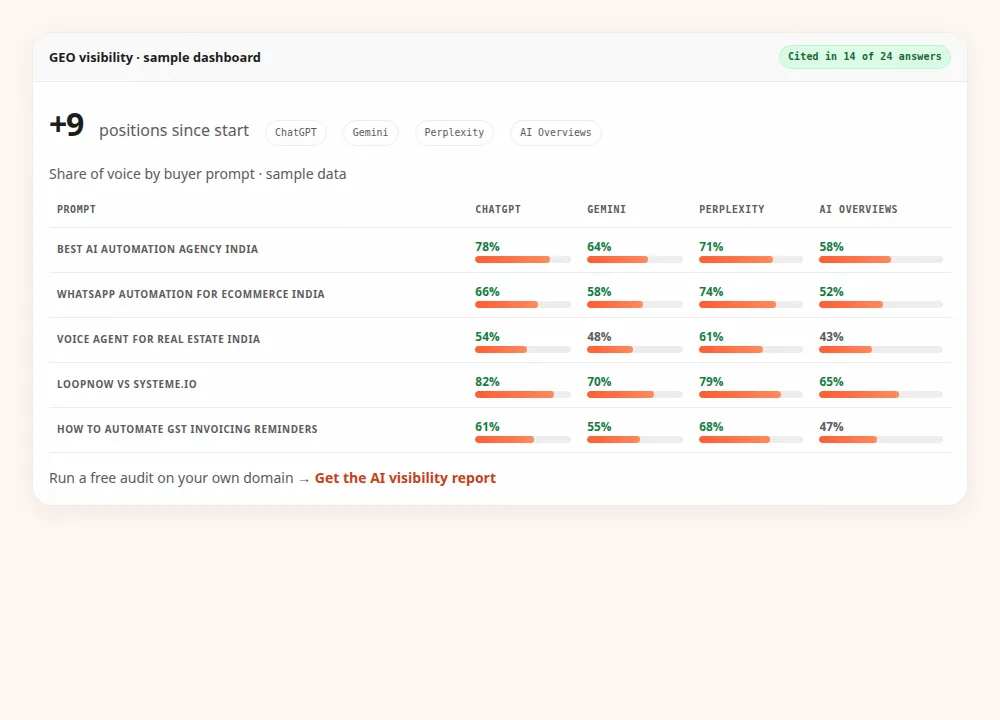
LoopNow includes GEO, which tracks how a brand appears in AI-generated answers and search summaries. Interakt does not offer it, according to the rows we checked, and that is not a criticism: the category is new, the measurement is unsettled, and a WhatsApp and CRM bundle has no reason to carry it. If you do not believe AI answer visibility is a channel yet, this row should carry no weight in your decision, and we would rather you ignore it than buy the plan for it.
If you do believe it matters, the practical value is in the same data model as everything else. A GEO finding, such as a competitor being cited for a query you should own, can become a task, a content brief or a campaign trigger in the same workflow that runs your WhatsApp follow-ups. That is a genuine advantage of a runtime over a point tool, and it is also the least proven part of our product. Treat it as an experiment with a measured outcome, not a reason on its own to migrate.
Consent, DPDP and the record an auditor will ask for
Both vendors sell into a market where DPDP is now part of procurement, and both describe consent handling in their documentation. Our comparison records LoopNow as keeping a consent ledger per contact with an erasure workflow, and Interakt’s approach is not described in enough detail in the rows we checked for us to grade it. That is a not-verified row, not an accusation. If consent evidence matters to your business, ask both vendors for a sample export and read the columns rather than the marketing page.
The questions are the same for both. What exactly did the customer agree to, on which channel, at what time, and for which purpose? When they withdraw, how quickly does the change reach a queued campaign and a second channel? Can you export the trail without asking an engineer? A small seller may never be asked, and a clinic or a lender will be. Answer the question for your own industry before you let a feature list answer it for you.
Billing, GST and the small-business cash cycle
Both products bill Indian customers in rupees with GST, which removes the currency problem that makes international platforms awkward for a small business. LoopNow prices are exclusive of 18% GST, with a GSTIN invoice on every payment and UPI, cards, netbanking and NEFT for annual plans. Interakt publishes Indian pricing and is built for the same market, so the billing comparison is less about currency and more about what each plan includes at the tier you will actually buy.
Cash flow matters more than list price for a business with seasonal revenue. A monthly plan with a spend cap is easier to carry through a slow quarter than an annual commitment, and an annual discount is only a saving if the business survives the year. LoopNow’s annual option saves 20% with a prorated refund inside the first 30 days, and monthly billing is available on every self-serve tier. Read the commitment clause before the discount, on either platform.
Migration and the Shopify question
Leaving Interakt is mostly a data exercise: contacts, tags, templates, automations and the WhatsApp number. LoopNow quotes about 48 hours for a typical migration done for you, which is realistic for a small account with a handful of flows. The complication is the storefront. If your WhatsApp automations read order status and cart events through Interakt’s Shopify app, those triggers have to be rebuilt against the new integration, and that work is invisible until you try it.
Plan the migration around one campaign, not the whole account. Move the list, rebuild the cart-recovery flow, run it alongside the old one for a week, and compare revenue per message. Keep the old tool active until the new flow has beaten the baseline or at least matched it. A cutover that removes your strongest automation before the replacement is proven is the most common way a platform migration loses money in month one.
Where Interakt is the better buy
Interakt is the better buy when you are a small seller who needs WhatsApp and a sales pipeline and nothing else. It is the better buy when Shopify is your storefront and the app marketplace covers your stack, because that ecosystem saves real hours and real money. It is the better buy when the entry price is the binding constraint, which for many first-year businesses it genuinely is. Saving ₹500 a month is meaningful when the alternative is not hiring someone.
It is also the better buy when the team is small enough that learning one product is the whole training budget. Interakt’s concepts are fewer, the CRM is inside the product, and a two-person team can be productive quickly. LoopNow asks a team to think in workflows, consent and channels, which is a larger mental model. For a business doing its first ₹1 crore of revenue, the simpler tool is often the correct one, and we would not talk a founder out of it.
Where LoopNow earns a higher entry price
LoopNow earns the extra ₹500 when the plan replaces more than one tool. A clinic that sends WhatsApp reminders, calls patients in Marathi and emails reports is buying three capabilities for one fee. A D2C brand that recovers carts on WhatsApp and email, and calls high-value customers before a delivery fails, is buying a workflow that no single-channel tool can run. The price gap is trivial against the cost of stitching those together with scripts and a shared spreadsheet.
It earns it, too, when the CRM exists and should not be duplicated. A company already running Zoho or Salesforce does not want a second pipeline in a messaging tool, and LoopNow’s connector model avoids that. The honest limit is scale: below a certain size, the extra capability is theoretical and the simpler bundle wins. Above it, the question stops being about ₹500 and starts being about how many systems your team is reconciling every week.
Frequently asked questions
Is Interakt cheaper than LoopNow?
At the published entry tier, yes: ₹2,499/mo against ₹2,999/mo for LoopNow Starter, both plus 18% GST according to our 4 November 2026 check. The gap is ₹500 a month. Whether it survives depends on what you would otherwise pay for email, voice and a CRM, so compare the total stack rather than the first line.
Does Interakt include a CRM?
Yes, a built-in sales CRM is part of the bundle, which is one of its main advantages for a small team that has no system of record. LoopNow does not sell a CRM; it connects to HubSpot, Zoho, Salesforce or Freshsales and writes outcomes back. If you have no CRM at all, a built-in one is immediately more useful.
How does Interakt handle voice calls?
Our comparison records voice as delivered through MyCallGenie, a separate product, while LoopNow includes voice agents in fourteen Indian languages on every paid plan. A separate product can be deeper on telephony, but it usually means a separate contract and a manual handoff. Ask both vendors to demonstrate a WhatsApp reply triggering a call automatically.
Can I use LoopNow with Shopify?
Yes. LoopNow has native ecommerce flows for Shopify and WooCommerce, plus eighteen native integrations and signed webhooks for anything custom. The difference from Interakt is the size of the third-party marketplace, not the existence of a Shopify connection. Check the specific apps you rely on rather than the catalogue size, because niche apps are where marketplaces matter.
Which platform is better for a first-year D2C brand?
Often Interakt, because the bundle covers the two things a new seller needs, messaging and a pipeline, at a lower entry price with fewer concepts to learn. LoopNow becomes the better choice when email and voice enter the picture or when a CRM already exists. Buying a runtime before you need one is a common and expensive mistake.
What happens to my WhatsApp number if I move?
The number belongs to your WhatsApp Business account and moves between solution providers through Meta’s approval process, on either platform. Expect a short migration window and plan it for a quiet period. Keep the old tool active until the new number is verified, and confirm the process in writing with both vendors before you start.
Does LoopNow really include GEO?
Yes, GEO is included on LoopNow plans, and Interakt does not offer it according to the rows we checked. GEO tracks how a brand appears in AI-generated answers. It is the newest and least proven part of the product, so treat it as an experiment with a measured outcome. If AI answer visibility is not on your roadmap, ignore this row entirely.
How long does migration take?
About 48 hours for a typical account: contacts, templates, automations, suppression lists and the WhatsApp number, done for you. Add time for storefront triggers if your flows read Shopify order or cart events, because those have to be rebuilt against the new integration. Run the new flow in parallel for a week before you switch the old one off.
Who should not choose LoopNow?
A small seller whose entire stack is WhatsApp plus a simple pipeline, especially one on Shopify whose apps are already covered by Interakt’s marketplace. In that case the higher plan fee buys capability you will not use, and the simpler product is the better product. We would rather you keep the ₹500 and revisit when email or voice becomes a real requirement.