LoopNow vs Klaviyo for Indian D2C
Klaviyo is the benchmark for ecommerce email and SMS. LoopNow adds WhatsApp, voice, DPDP consent records and INR/GST billing for Indian D2C teams.
One runtime vs point tool
LoopNow bundles email, WhatsApp, voice, workflow and GEO. If you only need one of those, the competitor may be cheaper.
| Criterion | LoopNow | Klaviyo |
|---|---|---|
| Ecommerce depth | Shopify/WooCommerce flows | Best-in-class |
| Official API + AI | SMS-first | |
| Voice | 14 Indian languages | Not core |
| Billing | INR, GST, UPI | USD |
| Data residency | AWS Mumbai | Global |
| Entry price | ₹2,999/mo + GST | USD, contact-based |
Competitor details checked 4 Nov 2026. Prices are exclusive of taxes; convert at ₹88/US$ where relevant.
We are not the right fit for everyone.
- You need the deepest Shopify segmentation and predictive analytics.
- Your team is already expert in Klaviyo flows.
- You do not need WhatsApp, voice or India-specific billing.
When LoopNow wins
You want one bill for email, WhatsApp, voice, workflow and GEO; Indian-language support; DPDP consent records; and AWS Mumbai residency.
Compare plans
The short version
- Klaviyo is the stronger product for ecommerce email depth: Shopify segmentation and predictive analytics are genuinely best in class, and we say so in our own comparison table.
- LoopNow is the broader runtime: email, WhatsApp, voice in fourteen Indian languages, workflow and GEO on one contact record, billed in INR with GST and UPI.
- The cost question is not the sticker price. Klaviyo prices in USD against contact volume; LoopNow publishes INR plans, and both change, so run the arithmetic on cost per delivered message.
- If your only marketing job is ecommerce lifecycle email and your team already thinks in Klaviyo flows, switching is likely to cost more than it returns.
- This comparison was written by LoopNow, a participant. Competitor details were checked on 4 Nov 2026 and prices move, so confirm current rates with the vendor before you sign anything.
Where Klaviyo genuinely leads, stated without hedging
Klaviyo built its position on one thing and built it well: the ecommerce data model. Profiles, events and catalogue data sit close enough together that a marketer can segment on what somebody bought, what they viewed, how often they ordered and what they are likely to spend next, then attach a flow to that segment without a data team in the room. Our own comparison row calls that depth best in class, and the phrase is not diplomacy. It is the accurate description of a product that has spent years on a single problem while we spent the same years on a runtime that carries several channels.
That distinction matters more than any feature list. A D2C brand whose growth calendar is built on browse abandonment, winback and predicted customer lifetime value will find more of the machinery already assembled in Klaviyo than in LoopNow. Our Shopify and WooCommerce flows cover the standard events, but they do not pretend to match the segmentation depth of a product built around ecommerce data for years, or the predictive properties that come with it. If that is the centre of your revenue engine, the honest recommendation is to keep the tool that owns it rather than to consolidate for its own sake.
The four-message problem an Indian D2C brand actually has
Consider a single prepaid order on a Shopify store in Pune. The confirmation email leaves one vendor, the shipping update leaves a second, a WhatsApp template fires from a third, a COD confirmation call is placed by a fourth, and the review request a week later is scheduled by whichever tool still has the contact. Four vendors means four suppression lists, four consent states and four invoices, and the failure that follows is predictable: somebody unsubscribes from email and still receives a WhatsApp broadcast, because the opt-out never travelled between systems.
The argument for a single runtime is not that every channel is equally good. It is that the contact record, the consent state and the suppression decision live in one place, so the second message respects what the first one learned. In LoopNow the same profile carries the email address, the WhatsApp number, the language preference and the consent ledger entry, and every channel checks that ledger at send time. The trade is real: you give up some depth in the channel we are weakest at, and you take on a product surface that is wider than a single-channel team needs.
The commercial version of the same point is simpler. When email, WhatsApp and voice sit on one plan, adding a channel is a change to an allowance rather than a new procurement cycle. When they sit with three vendors, every new channel adds a contract, a security review and a reconciliation exercise at month end. Neither arrangement is free; they fail in different places.
Cost with GST: the arithmetic to run before the demo
LoopNow prices are quoted in INR and exclude 18% GST, which is the convention Indian B2B buyers use because it keeps input credit visible. Starter is ₹2,999 a month, Growth ₹7,999, Scale ₹24,999, and Enterprise starts at ₹75,000; add GST and the monthly cash outlay becomes roughly ₹3,539, ₹9,439 and ₹29,499. Annual billing takes about 20% off, which moves Starter to ₹2,399 a month before tax. None of that is a comparison with Klaviyo, because Klaviyo bills in USD against contact volume and the number moves as your list grows.
The mistake buyers make is comparing a plan price to a plan price. The useful unit is cost per delivered message across every channel you actually use, including the ones you pay for twice because two vendors both hold the same contact. Add the FX movement on a dollar invoice, the card fee, and whatever your finance team does about tax treatment on imported software, and a headline that looked cheaper can lose its advantage at a few thousand contacts.
So ask three questions in the demo. What is the overage rate per delivered email, per WhatsApp message and per voice minute, and is it capped? What happens at the next contact tier? And which of these meters stops rather than bills when the allowance runs out? LoopNow answers all three on the pricing page, with spend cap on by default and overage never above the pay-as-you-go rate. We cannot answer them for Klaviyo, and we would not quote their rates from memory.
Shopify and WooCommerce: what depth buys and what breadth buys
Both products can read an order and send a message about it. The difference is what happens between those two points. Klaviyo exposes a wide event surface, keeps a long profile history and lets a marketer compose conditions until the segment matches exactly the cohort they have in mind. LoopNow reads the same storefront events, maps them into a workflow canvas, and then routes the outcome to email, WhatsApp or a voice call. For a standard abandoned checkout, a winback or a post-purchase sequence, both are competent. For a segmentation model with fifteen conditions and a predicted value attached, only one of them is built for it.
Breadth buys something else. A WooCommerce store in Jaipur with a COD-heavy mix needs a confirmation call before dispatch, a WhatsApp message when the courier is two stops away, and an email invoice for the accountant. None of those is an ecommerce segmentation problem; they are routing problems, and routing is what a workflow engine with human gates is for. The same canvas can hold a step that waits for a human to approve a refund, which is not something an email flow builder is designed to express.
Our recommendation is unfashionable but simple: keep the tool that owns the data model you depend on, and add the runtime that owns the channels it does not cover. Consolidation is a means, not a goal, and a two-tool stack that each does its job is often cheaper than one tool doing both badly. The exception is a team small enough that a second console never gets opened, where a single bill genuinely reduces the chance that a message is never sent.
WhatsApp is not SMS with a different logo
On paper both are short messages on a phone. Operationally they are different products with different economics. WhatsApp Business Platform messages are template-based, approved per category, and priced per delivered message in India at ₹1.15 for marketing and ₹0.22 for utility and authentication on our plans. SMS in India runs through DLT registration, with sender IDs and templates registered before a single message can leave, and the cost per message is set by your operator relationship rather than by your marketing platform. A team that treats the two as interchangeable will build the wrong sequence and misread the bill.
Klaviyo is SMS-first, which is a statement about where the weight of the product sits rather than a claim that no other path exists. For an Indian brand the practical consequence is that the channel most likely to be read within four minutes, WhatsApp, is not the channel the tool is organised around. That is not a flaw in Klaviyo; it is a fit question. If your customers are in the United States and your lifecycle runs on SMS and email, the shape is right. If your customers are in Tier 2 and Tier 3 India, the same customer checks WhatsApp before email and often does not read email at all.
There is a compliance dimension too. WhatsApp requires opt-in and a template approval before you can message, which forces a discipline that email marketing has spent two decades avoiding. Our consent ledger records the opt-in with its timestamp and source, and the template category determines the price. That is dull plumbing, but it is the difference between a channel you can scale and one that gets your business number restricted.
Predictive analytics: what it is for, and where it misleads
A predicted customer lifetime value is a convenience, not a fact. The model looks at historical behaviour across a population and produces a number for one person, and that number is only as good as the volume and cleanliness of the events behind it. On a store with four hundred orders a month and a six-month history, predictions are noisy enough that acting on them can be worse than acting on a simple rule such as ordered twice in ninety days. On a store with tens of thousands of orders across several years, the same model earns its place in the calendar.
This is where Klaviyo’s investment shows. Predictive properties sit inside the segmentation builder, so a marketer can combine a predicted value with a real behaviour and a real recency window without exporting anything. We do not sell a comparable model as a headline feature, and we would rather say that plainly than ship a score with a confident label. What we ship is rule-based segmentation, event-driven workflows and agents that propose the next action from recent activity, which is a weaker claim and an honest one.
For most teams below a few crore of annual online revenue, the useful question is not which model is better but whether the data going in is trustworthy. Duplicate profiles from guest checkout, orders imported twice during a platform migration, refunds recorded as new sales: those problems flatten the difference between a good model and a mediocre one. Fixing identity before buying prediction is the sequence that actually improves revenue, and it is the first thing we look at in a migration call.
Residency, DPDP and the consent ledger question
Indian procurement now asks where the data sits before it asks what the product does. LoopNow runs on AWS Mumbai, ap-south-1, and our comparison row records Klaviyo as global rather than India-specific. For a company with a security questionnaire, that single line can decide the shortlist before a demo is booked, and no amount of feature parity changes it. It is also not a moral hierarchy: a global platform can be perfectly lawful to use, and many Indian companies do so with appropriate contracts in place.
What residency does not do is make you compliant. The Digital Personal Data Protection Act puts the obligation on the data fiduciary, which is your company, and it asks for a notice, a lawful basis, a way to withdraw, and erasure when the purpose ends. A Mumbai region helps with the storage question and does nothing for the consent question. That is why we treat the ledger as the product and the region as a setting: every contact carries the notice version they saw, the purpose they agreed to, the channel and the timestamp, and a withdrawal propagates to every send path rather than sitting in one tool.
One caveat belongs here because it is routinely skipped in vendor comparisons. When you send a WhatsApp message, the message is processed by Meta under Meta’s terms regardless of where your marketing platform stores its database. Residency of the platform is not residency of the channel. If a procurement questionnaire asks about end-to-end data flows, the honest answer names every processor in the chain, and we would rather lose a deal than draw that diagram inaccurately.
A migration timeline that does not break a festive quarter
The mechanical part of a migration is quick. Contacts, templates, suppression lists and the WhatsApp Business number move in about forty-eight hours when we do it for you, because most of it is export, transform and import rather than re-architecture. The part that takes longer is the flows, and it takes longer because nobody has a complete list of them. Every live automation, every quiet rule that only one person knows about, every segment that exists because a campaign in 2024 needed it: all of that has to be read, mapped and either rebuilt or retired.
A realistic shape for a mid-sized D2C brand is three weeks with a parallel run in the middle. Week one is export and inventory: profiles, events, consent timestamps, suppression reasons, and a written list of every flow with its trigger and its exit condition. Week two rebuilds the flows that survived the inventory and runs them alongside the old ones against a small segment, with both tools live and one clearly designated source of truth. Week three is cutover, which means freezing the old flows rather than deleting them, keeping the domain and its authentication history, and watching complaint rates daily for a fortnight.
The risks are known and boring. Suppressed addresses get dropped in a CSV round trip and start receiving mail again. Consent timestamps arrive as a single import date, which destroys the evidence. A WhatsApp number moves without the business portfolio transfer, and the display name has to be re-approved. Historical analytics do not travel, so year-on-year comparisons restart. Each of these is avoidable with a checklist, and each of them has ended a migration that looked finished.
Voice agents for COD confirmation, returns and NDR
The calls an Indian D2C brand needs are short, repetitive and time-bound. Confirm a cash-on-delivery order before dispatch, reschedule a delivery, arrange a return pickup, chase a non-delivery report. Each is two to four questions with a clear outcome, which is exactly the shape a voice agent handles well and a human team handles expensively. Our voice channel runs in fourteen Indian languages at ₹2.20 a connected minute inside a plan and ₹2.50 pay-as-you-go, so a thousand calls averaging forty seconds is roughly ₹1,467 of consumption rather than a hiring decision.
Klaviyo is not built around voice, and our own table says so. That is not a criticism of the product; a channel that requires telephony, language models and latency engineering is a different business from email segmentation. But it does mean the comparison is not symmetrical. If COD confirmation is a line item in your operations budget, you are already paying somebody for it, and the question is whether that spend belongs inside your marketing runtime or beside it.
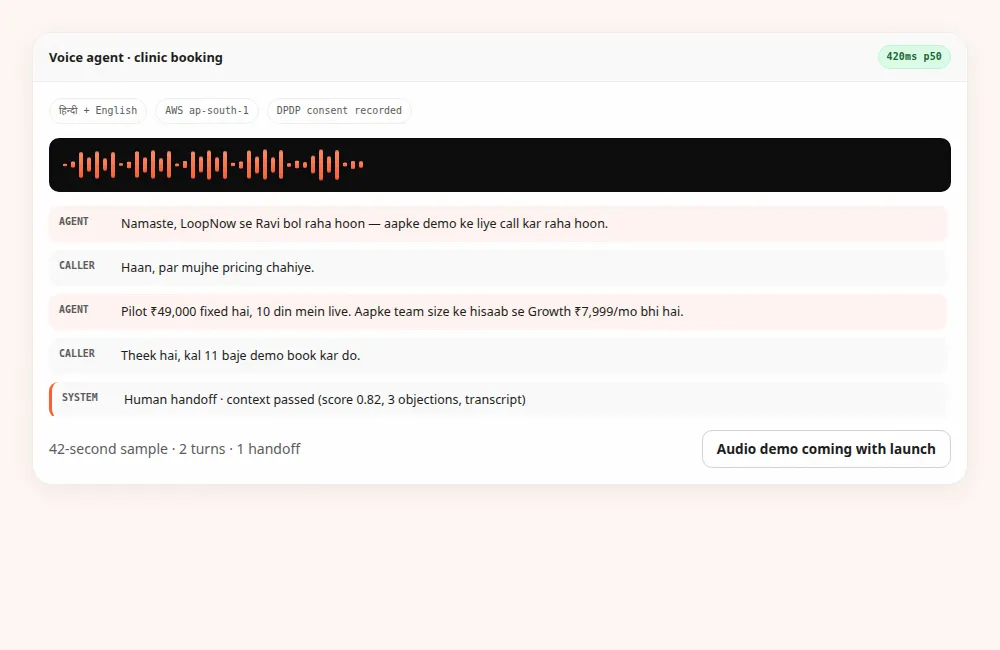
The caveat is worth stating loudly. A voice agent that mishears an address or talks over a customer damages a brand faster than a clumsy email, because the customer is present and the failure is audible. Latency, barge-in handling, a clean handoff to a human and a recording policy that satisfies your legal team matter more than the number of languages on the datasheet. We would rather run a hundred calls in production with you than promise a smooth launch from a demo.
Who should not choose LoopNow, and what to do instead
If the centre of your revenue is ecommerce lifecycle email and your team is fluent in Klaviyo flows, stay where you are. This is not a consolation prize. The switching cost includes rebuilding every flow, losing the predictive history and retraining the people who run the calendar, and the benefit, for a team that only needs email and SMS, is close to zero. We would be taking money for a product surface you would not open.
The same answer applies if you do not need Indian billing, Indian residency or Indian-language voice. Those three are the reasons we exist, and a buyer who does not value them is paying for work we did on their behalf and will never use. The fit is a team that already spends on WhatsApp, already pays for outbound calls, already fields DPDP questions from a customer or an investor, and is tired of reconciling four invoices for one customer journey.
This page is written by LoopNow, which makes us a participant rather than a referee. Competitor details were checked on 4 Nov 2026 against public product and pricing material, and prices change, so verify current rates with Klaviyo before you commit. If a call with us ends with you staying on Klaviyo for another year, that is a legitimate outcome, and it is cheaper for you than a migration you did not need.
Frequently asked questions
Is LoopNow cheaper than Klaviyo?
Not necessarily, and a plan-to-plan comparison will mislead you. Klaviyo prices in USD against contact volume, so the figure moves with your list and the exchange rate. LoopNow publishes INR plans that include WhatsApp, voice and email allowances. Compare total cost per delivered message across every channel you use, with GST and FX included, rather than the headline number.
Can I run Klaviyo for email and LoopNow for WhatsApp and voice?
Yes, and for some teams that is the right answer. The risk is two consent states: somebody opts out of WhatsApp in LoopNow while Klaviyo still holds them as subscribed for email. Keep one system as the source of truth for consent and sync the other from it, or the compliance gap will appear in an audit rather than in a dashboard.
How deep is LoopNow on Shopify?
Enough for standard flows: order confirmation, shipping, abandoned checkout, winback and post-purchase, with catalogue and order events. It is not a match for Klaviyo segmentation with predicted properties attached to each condition. If your calendar depends on that depth, we will say so on the call rather than rebuild something weaker.
What happens to my Klaviyo history if I move?
Profiles, suppression reasons and consent timestamps can be exported and imported. Historical campaign analytics generally cannot be reconstructed in a new tool, so your year-on-year reporting restarts at cutover. Plan for that by exporting reports you need for finance or board packs before the old account closes.
Is WhatsApp marketing allowed without opt-in?
No. The WhatsApp Business Platform requires opt-in before you can message a person, and templates must be approved per category. Marketing templates are priced higher than utility templates on our plans, at ₹1.15 against ₹0.22 per delivered message. Consent is recorded with its source and timestamp so a template restriction can be traced to a decision.
Where does LoopNow store data?
In AWS Mumbai, ap-south-1, for the runtime and its storage. That does not cover every processor in a customer journey: WhatsApp messages are handled by Meta under Meta’s terms, and payment data stays with your payment provider under RBI rules. A procurement review should map the whole chain rather than a single region.
How long does a migration from Klaviyo take?
Contacts, templates, suppression lists and the WhatsApp number typically move in about forty-eight hours with our team doing the work. Flows take longer, usually two to three weeks including a parallel run. The first workflow on the new runtime is usually live inside ten days, and nothing is switched off until the numbers match.
Do I keep my sending domain?
Yes. Keep the domain and the subdomain, re-publish the authentication records the new platform requires, and warm the new path before moving bulk volume. Reputation belongs to the domain over time, but a new sending path still needs a ramp. Never delete the old records until the new ones are verified as passing.
What is on the free plan?
One thousand marketing contacts, five thousand emails, one hundred voice minutes and two hundred and fifty WhatsApp messages a month, with one agent and one workflow, free forever and no card. It is enough to run a real pilot on a small list rather than a demo with sample data.
Who is definitely not a fit for LoopNow?
A team whose only job is ecommerce lifecycle email and SMS at depth, with no WhatsApp, voice, Indian billing or residency requirement, should stay on Klaviyo. A single-channel team will pay for breadth it does not use. We would rather tell you that than sell a migration you would regret in the second quarter.