LoopNow vs Wati for WhatsApp teams
Wati is a polished WhatsApp team inbox with strong integrations. LoopNow is an agent runtime: WhatsApp is one channel, alongside voice, email, workflow and GEO.
One runtime vs point tool
LoopNow bundles email, WhatsApp, voice, workflow and GEO. If you only need one of those, the competitor may be cheaper.
| Criterion | LoopNow | Wati |
|---|---|---|
| Team inbox | Included | Core strength |
| AI agents | Multi-agent runtime | AI add-on |
| Voice | 14 Indian languages | Not core |
| Included | Not core | |
| India billing | INR, GST, UPI | USD billing, GST on request |
| Integrations | 18 native + signed webhooks | 100+ integrations |
Competitor details checked 4 Nov 2026. Prices are exclusive of taxes; convert at ₹88/US$ where relevant.
We are not the right fit for everyone.
- You need the deepest WhatsApp inbox and integration catalogue.
- Your team already works inside Wati and switching is not worth it.
- You do not need email, voice or workflow.
When LoopNow wins
You want one bill for email, WhatsApp, voice, workflow and GEO; Indian-language support; DPDP consent records; and AWS Mumbai residency.
Compare plans
The short version
- Wati is a polished WhatsApp team inbox with a large integration catalogue, and inbox depth is the job it does better than we do.
- LoopNow treats WhatsApp as one channel on a runtime that also carries email, voice, workflow and GEO, with a consent ledger behind all of them.
- The practical difference shows up in billing: our table records Wati as USD billing with GST on request, against INR plans with GST invoices and UPI.
- If your operation is a WhatsApp support desk and nothing else, Wati’s inbox and integrations are a better fit than a broader runtime.
- LoopNow wrote this comparison and is a participant in it. Competitor details were checked on 4 Nov 2026; prices change, so verify them with the vendor.
WhatsApp inbox depth is a real skill, and Wati has it
A shared inbox sounds like a simple product and is not. Several agents have to see the same conversation without answering over each other, a supervisor has to reassign a chat without losing the context, and the history has to survive a shift change. Add labels, canned replies, contact attributes and a queue that respects business hours, and you have a product that took years to make feel obvious. Wati’s core is exactly this, and our comparison table names the team inbox as its core strength rather than a feature it happens to include.
Our inbox is competent and it is not the centre of the product. WhatsApp sits on a runtime alongside email, voice and workflow, which means the inbox is designed to route a conversation into a journey rather than to be the place a support team lives for eight hours. For a team that does live in the inbox, the accumulated detail of a dedicated product is visible immediately: keyboard behaviour, assignment rules, the way a supervisor can scan twenty conversations at once. We would not claim parity, and a buyer who tests both will see the difference inside an hour.
The useful question is what the inbox is for. If it is the primary workspace for a support function, depth wins and Wati is the better purchase. If it is one surface among several, and the important work is the sequence that starts before the message and continues after it, a runtime with a decent inbox is the more useful shape. Both answers are legitimate, and they depend on headcount and process rather than on ambition.
A support shift, seen from the agent’s chair
The best way to compare two inboxes is to watch an eight-hour shift rather than a demo. A conversation arrives at 10:12 from a customer asking where an order is. The agent looks up the order, replies with a template, and the customer answers with a photo of a damaged box. That is a different problem, so the chat is relabelled and reassigned to a returns queue. At 14:30 the customer follows up because nobody replied, and the second agent has to read the whole thread to understand what happened. At 18:00 the shift ends and the chat is still open.
Every step in that story is a product decision. Does the assistant have the order data in the same pane, or does it open a second tab? Does a relabel trigger a routing rule or just a colour change? Does the second agent inherit a summary or raw history? Does the end of a shift leave an unassigned chat in a queue or nothing at all? A dedicated inbox has answers to all of these because it was designed around the shift. A runtime has answers to the ones that matter for routing into a journey, and leaves the rest to process.
Our honest assessment is that the first half of the story is better in Wati and the second half is better with us. The follow-up at 14:30 is a workflow problem: something should have waited four hours, checked whether the chat was answered, and escalated on WhatsApp or by voice. That is what a canvas with a human gate is for, and it is why we keep saying the two products are answering different questions.
The integration catalogue, counted honestly
Our table records eighteen native integrations plus signed webhooks on LoopNow, against more than a hundred on Wati. The gap is real and it is the cost of focus. A product that has spent years integrating with ecommerce platforms, helpdesks, CRMs and payment tools accumulates connectors that a broader runtime has not built, and a team that needs a specific connector on day one should weight that heavily. A missing integration is not a small inconvenience; it is a build project, a maintenance obligation and a reason a pilot stalls.
We compensate with webhooks rather than a connector count. Any system that can receive an HTTP request with a signature can be wired into a workflow, and any system that can send one can trigger it. That covers most custom stacks and none of the convenience. A native connector is a product decision someone else has already debugged; a webhook is a small amount of engineering you now own. For a team with a developer, webhooks are fine. For a team without one, the catalogue is the difference between a working tool and a backlog item.
The question to ask is not how many integrations exist but which five you need in the first month. Write them down before the demo, check both vendors against the list, and treat everything beyond the list as optional. Vendor pages count connectors differently, grouping a family of related actions as one entry, so the headline number is a rough signal rather than a specification.
AI replies: an add-on versus a runtime
An AI reply bolted onto an inbox usually does one thing: it suggests or sends an answer to a message. That is genuinely useful, and for a support queue it removes a large amount of typing. What it does not do is decide that this conversation should become a voice call, or that the person asking about a return should receive a pickup link and a WhatsApp confirmation when the courier is assigned. Those are orchestration decisions, and they live above the reply.
Our agents sit inside the runtime, which means an agent can read the contact record, check consent, call a workflow, hand off to a human, and write the outcome back to the same profile. The trade is that the agent is part of a larger system with more configuration and more ways to be wrong. A single-purpose AI reply has a smaller surface and fails in a smaller blast radius. If your need is faster first responses on WhatsApp, the narrower tool is easier to justify.
The failure mode worth guarding against in both designs is the confident wrong answer. An agent that invents a delivery date or a refund policy creates a commitment the business has to honour. Our default is to constrain the agent to retrieved facts, escalate when the retrieval is empty, and never let it promise a date it cannot see in the order system. That is slower to build than a general reply bot and considerably cheaper than a legal review of a thousand wrong promises.
Invoicing in dollars with GST on request
A WhatsApp platform is often bought by a marketing or support manager on a card, which is why so many of them bill in USD. It works, and it creates a recurring task for finance: convert the charge, match it to a receipt, and obtain a tax document separately if one is available at all. Our table records Wati as USD billing with GST on request, which is a fair description of a common pattern rather than a criticism of the product. Many Indian teams operate this way without difficulty.
LoopNow bills in INR with GST included on the invoice at 18%, printed against your GSTIN, and accepts UPI, netbanking, cards and NEFT for annual plans. The benefit is administrative rather than strategic: the number on the invoice matches the number in the budget, input credit is straightforward, and a purchase order does not need a currency clause. For a company of a certain size, that alone can decide a vendor.
It is worth separating the billing question from the price question, because they get conflated. A USD invoice is not automatically more expensive, and an INR invoice is not automatically cheaper. What changes is the work and the predictability. If your finance team has a smooth process for foreign software subscriptions, the currency is a detail. If every renewal produces a fortnight of reconciliation, it is not.
When WhatsApp is not enough: voice and email
A WhatsApp-only stack runs into two walls that are predictable and close together. The first is the customer who does not answer on WhatsApp, which in India is often the customer over fifty or the one who gave a landline at checkout. The second is the message that cannot be sent on WhatsApp at all, because the template was rejected, the opt-in is missing, or the content is a long invoice that belongs in email. A support team then reaches for a personal phone and a mail client, and the record splits.
Our answer is to put email and voice on the same contact record. A failed WhatsApp delivery can trigger an email, a COD order can trigger a call, and the transcript lands next to the chat history. This is not a claim that voice is easy; it is a claim that the coordination is easier when the channels share an identity. The cost is that each channel has its own learning curve and its own pricing meter, and a team that only needs WhatsApp is paying for surface it will not use.
For a WhatsApp-first business, the honest test is whether the exceptions are frequent enough to justify a second channel. Count the conversations that ended because the customer did not reply on WhatsApp, and the orders that needed a call before dispatch. If that number is small, a dedicated WhatsApp tool plus a phone is cheaper and simpler. If it is a standing operational cost, the runtime starts to pay for itself.
Human handoff and the gates that keep quality
Automation in a support channel fails in a specific way: it keeps going after it should have stopped. The customer says the word refund for the third time, the agent offers the same policy paragraph, and the conversation becomes a complaint about the conversation. The fix is not a better model; it is a gate. After two failed attempts, or on a keyword, or when sentiment drops, the workflow should stop automating and put a person in front of the customer with the full context attached.
Our canvas treats a human gate as a step rather than an exception. A workflow can pause, assign a task, wait for approval and continue with the decision recorded. That matters for refunds, cancellations and anything with a financial consequence, where an automated decision is a liability rather than a convenience. It also produces an audit trail, which is useful when somebody asks why a particular customer received a particular outcome.
The measurement that keeps this honest is containment with a quality floor. A bot that resolves eighty percent of conversations by refusing to escalate is worse than one that resolves fifty percent and hands the rest over cleanly, because the second number includes the complaints that never happen. We report resolution and handoff separately for that reason, and we would encourage any buyer to ask the same question of both vendors.
The numbers behind a WhatsApp bill
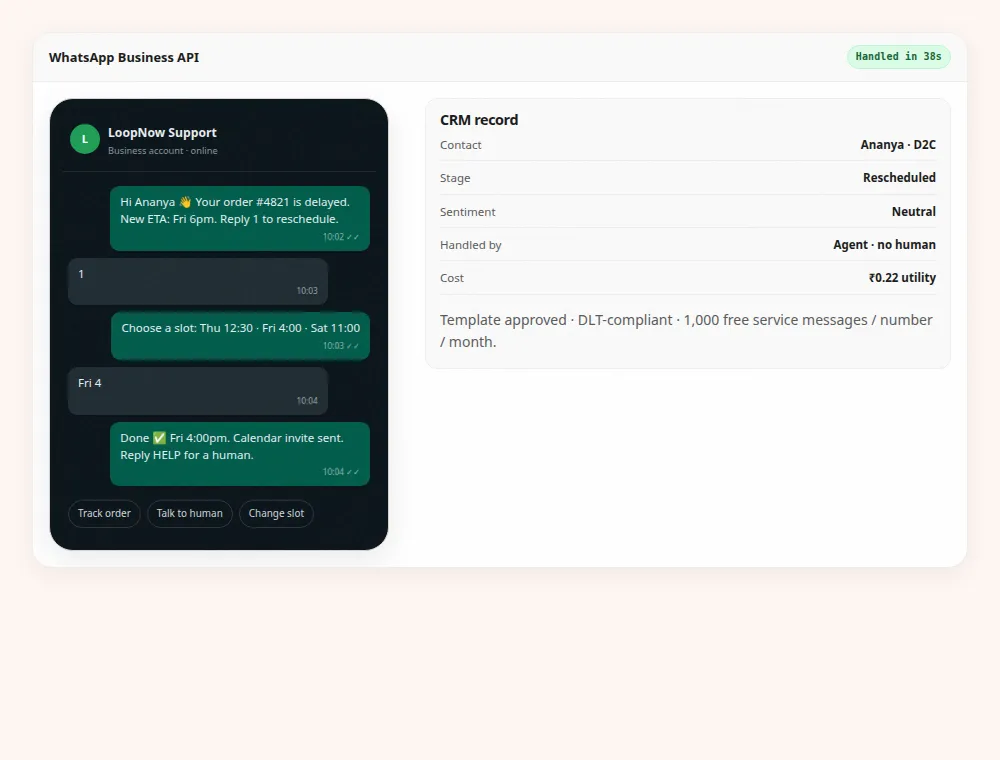
WhatsApp pricing is per delivered message and depends on the template category. On our plans a marketing template is ₹1.15 and a utility or authentication template is ₹0.22, so the same campaign can cost five times more depending on how it is classified. Classification is not a marketing choice; it follows the content. A promotional offer is marketing even if it is useful, and a delivery update is utility even if it mentions the brand. Misclassifying to save money is the fastest way to lose a number.
Two platform rules shape the bill more than any optimisation. Opt-in is required before you can message, and a template has to be approved before it can be sent. That means the cost of a campaign includes the lead time to get a template approved, and a rejected template can delay a launch by days. It also means the quality of your opt-in list is the real ceiling on volume, because bought or scraped numbers generate blocks and reports that put the number at risk.
The last number to watch is the conversation window. Outside the customer service window, you can only send approved templates, which is why a support reply that arrives late is not just slow but potentially impossible without a new template. A workflow that escalates within the window is worth more than one that escalates elegantly two hours later. That constraint exists on every WhatsApp platform, and no vendor can design it away.
Moving a WhatsApp number without losing the thread
The number is the most fragile part of a migration and the part teams underestimate. A WhatsApp Business number is tied to a business portfolio and a display name, and moving it between providers is a transfer rather than an export. If the display name has to be re-approved, messages sent during the gap may fail, and a customer who tries to reply to an old thread may end up in a different place than the new inbox expects.
The sequence that works is to plan the transfer for a low-traffic window, keep the old provider live until the new one confirms it can send and receive, and tell the support team what a failed send looks like so they recognise it immediately. Templates should be re-submitted before the cutover rather than after, because approval is asynchronous and the queue is not yours to control. Chat history is usually not portable in full, so export anything the business needs for a dispute before the old account closes.
Two operational details are worth writing down. First, the opt-in list is your asset and it should be exported with its source and timestamp, not just the phone numbers. Second, any automation that sends on a schedule should be paused a day before the move and resumed a day after, because a campaign firing during a transfer is the most common cause of a number getting restricted. Neither step is difficult; both are forgotten under deadline pressure.
Who should stay on Wati
Stay on Wati if WhatsApp is the business. A support desk with a dozen agents, a catalogue of integrations that already works, a team that knows the product and a queue that runs eight hours a day: that is a focused tool doing a focused job, and the integration depth is not something we can match today. Our own table lists three situations where the competitor wins, and the first two are exactly this.
We are the better fit when WhatsApp is one lane of a wider journey, when email and voice are already line items, when the invoice has to be in rupees, or when the same team owns a DPDP questionnaire. Those conditions describe a mid-market Indian business more often than they describe a pure support operation, which is why the runtime exists at all.
This comparison is written by LoopNow, which makes it advocacy as well as analysis. Competitor details were checked on 4 Nov 2026 against public product material, and prices change, so confirm current rates with Wati. If the test comes out in favour of the inbox, take it: a tool your team already knows is worth more than a broader one they have to learn.
Frequently asked questions
Is LoopNow a WhatsApp inbox or a marketing platform?
Both, and neither is the centre. WhatsApp sits on a runtime with email, voice, workflow and GEO, and the inbox is designed to route a conversation into a journey rather than to be the only place work happens. If you want a dedicated inbox with years of refinement, Wati is the stronger product for that single job.
How many integrations does LoopNow have?
Eighteen native integrations plus signed webhooks, against more than a hundred on Wati according to our comparison table. The gap is real. If a specific connector is on your first-month list, check it before the demo, because a missing native integration becomes a build project rather than a configuration task.
Why does USD billing matter for an Indian team?
It adds steps rather than cost: an FX conversion, a card fee, a receipt in one currency and a ledger entry in another. Our table records Wati as USD billing with GST on request. LoopNow issues an INR invoice with 18% GST and your GSTIN printed, which removes the reconciliation but does not automatically make the plan cheaper.
Can I use LoopNow for a support desk with twelve agents?
It can run the queue, but Wati’s inbox is more refined for that specific pattern: assignment, labels, supervisor views and shift handover. We would rather you test both with a real shift than take our word for it. Where we add value is the workflow that escalates an unanswered chat to a call or an email.
What does a WhatsApp message cost on LoopNow?
₹1.15 per delivered marketing template and ₹0.22 for utility or authentication. The category follows the content, not the campaign name, so a promotional message is marketing even if it is useful. Template approval and opt-in are platform requirements that apply to every vendor, and they set the real ceiling on volume.
Do you support the 24 hour customer service window?
Yes. Outside the window only approved templates can be sent, which is why escalation timing matters. A workflow that hands a conversation to a human within the window is worth more than one that escalates later and has to start a new template conversation. The rule is set by WhatsApp, not by the vendor.
Can I move my WhatsApp number without downtime?
Not always without a short gap, but you can keep it to minutes. Plan the transfer for a low-traffic window, keep the old provider live until the new one confirms send and receive, resubmit templates in advance, export the opt-in list with source and timestamp, and pause scheduled automations for a day either side.
Does the AI agent answer without a human?
It can, within limits you set. Our default is to constrain replies to retrieved facts, escalate when retrieval is empty, and never promise a delivery date or refund the agent cannot see in the order system. Refunds and cancellations route to a human gate by default, with the decision recorded against the contact.
Who should not choose LoopNow?
A WhatsApp-only support operation with a working integration catalogue and a team fluent in the incumbent inbox. In that case the switch costs training and integration work for a benefit the team will not use. A pure inbox is a legitimate purchase, and our own table says so.