AI SDR
A sales development agent that researches accounts, scores ICP fit, runs sequences and logs every touch to the CRM before it hands off.
An AI SDR researches accounts, scores ICP fit, runs multi-channel sequences and books meetings. It should log every touch to the CRM and hand off to a human when the deal is real.
An AI SDR researches accounts, scores ICP fit, runs multi-channel sequences and books meetings. It should log every touch to the CRM and hand off to a human when the deal is real.
All glossary terms
The short version
- An AI SDR is a sales development agent: it researches accounts, scores fit against an ideal customer profile, runs multi-channel sequences, handles replies and books meetings, then hands the deal to a human.
- It is not a chatbot on the website, and it is not an email sequencer with a language model bolted on. The difference is the loop from research to booked meeting, with CRM write-back at every step.
- In India the channel mix decides the design: email for reach, WhatsApp only with opt-in and an approved template, voice inside do-not-disturb and calling-hour rules, and no channel without a suppression path.
- Fit scoring has to be explainable. A score the sales team cannot interrogate gets ignored within a month, and an ignored score is worse than no score.
- Measure meetings held per thousand contacts and cost per meeting with human time included. Reply rate alone rewards volume and hides damage to the domain.
- An AI SDR that books meetings nobody wanted is an expensive way to create churn in the pipeline review.
AI SDR, defined by the job it does
An AI SDR is an agent that performs sales development work: it builds a target list, researches each account, scores fit, writes and sends sequences across channels, reads replies, answers routine questions, books meetings into a calendar and logs everything to the CRM. The output is a qualified conversation with a human seller, not a newsletter subscription and not a demo request form.
The job framing matters because it sets the success test. A sequencer is measured on sends. An SDR is measured on meetings that hold, with the right people, at accounts that could plausibly buy. If an AI SDR is judged on open rates it will optimise for subject lines; if it is judged on meetings held, it will be forced to get the targeting and the qualification right.
What an AI SDR is not: it is not a support bot, it is not a website chat widget, and it is not the whole of agentic AI. Agentic AI is the capability class, an Agent OS is the runtime, and an AI SDR is one job built on both. A company can run agentic workflows in finance and support without ever owning a sales agent, and the controls are similar even though the work is different.
The work, broken into tasks that can be checked
List building is the first task and the one most likely to be automated badly. A good list names the segment, the geography, the size band and the trigger, such as a new funding round, a new plant or a recent product launch. A bad list is a bought file with job titles. Under the DPDP Act, personal data must be processed for a lawful purpose with notice and, for marketing, a consent basis you can evidence. Buying a list does not create that basis.
Research is the second task: what the company does, how it sells, which tools it appears to use, whether it is hiring for the role your product supports. This is where a language model earns its place, because it can read a website and a job posting and produce a short brief. It is also where it invents things. Every research claim that reaches a message should be traceable to a URL, and a claim without a source should be dropped rather than softened.
Scoring, sequencing, reply handling and booking follow. Each is a separate evaluable task, and each has a failure that shows up downstream: a wrong score wastes sends, a bad sequence damages the domain, a misread reply insults a buyer, and a badly booked meeting wastes a seller’s afternoon. Treating them as one blob is why so many AI SDR pilots cannot explain their own results.
How it differs from a human SDR and from marketing automation
A human SDR brings judgement that a model does not have: the feel for a stalled conversation, the willingness to break a script, the relationships that predate the job. An AI SDR brings consistency, coverage across time zones and the patience to personalise at a volume no human sustains. The strongest configuration is usually a human owning the account strategy and the late-stage conversation, with the agent doing research, first touch, follow-up and scheduling.
Marketing automation is different again. It moves a contact through a predefined journey triggered by behaviour, and it is excellent at nurture at scale. It cannot read a reply and decide that this particular objection needs a different argument. An AI SDR operates on named accounts with a goal, which is why it belongs closer to sales than to marketing operations, even though it uses the same email and WhatsApp infrastructure.
The comparison that matters commercially is cost per meeting, not cost per contact. A human SDR costs a salary, a seat and a manager, and produces a small number of high-context conversations. An AI SDR costs a subscription, message and token fees, and produces more low-context attempts. The right mix depends on deal size: a ten lakh rupee contract justifies a human, a fifty thousand rupee contract may not.
The Indian data foundation
Indian B2B data is messier than the tooling assumes. Company names vary between the legal name, the brand and the spelling used on LinkedIn. The same group appears as three entities. Phone numbers are recycled. Email addresses are often role-based, and a large share of decision makers prefer WhatsApp to email for the first reply. An AI SDR built on a clean-looking import will spend its first month discovering this.
Three public sources help. The Ministry of Corporate Affairs registry gives the legal name, incorporation date and registered office for companies, which is useful for deduplication and for confirming that an entity exists. The GSTIN, a fifteen character identifier, confirms registration and state, and its format can be validated before it is used in an invoice or a segment. Company websites and job postings give the operational facts: what they sell, where they hire, which systems they mention.
The discipline is to keep provenance on every field. Where did this phone number come from, when was it verified, and what is the lawful basis for contacting it. A record without provenance cannot be defended in a DPDP request and cannot be cleaned when it goes stale. Role-based addresses like info@ should be treated as company contact points, not as personal data belonging to a named individual.
Channels, consent and the Indian rulebook
Email is the backbone and it has the strictest infrastructure requirements. SPF, DKIM and DMARC must be correct before the first campaign, the sending domain should be separate from the transactional domain, and volume should ramp. Google’s bulk sender rules require one-click unsubscribe and honour it within two days, and complaint rates above the published threshold damage the domain for everyone in the company, not just the agent.
WhatsApp is the highest-intent channel and the most tightly governed. A business cannot message a person who has not opted in, and outside the twenty-four hour service window it must use an approved template in the right category. A marketing template costs more than a utility one, and the category must match the content. An AI SDR that treats WhatsApp like email will get the number quality-rated down, which is a business-wide outage rather than a campaign failure.
Voice and SMS add two more regimes. Commercial SMS in India runs through DLT registration of the entity, the header and the template. Outbound voice has to respect do-not-disturb status and regulator-set calling hours, and a marketing consent for WhatsApp does not authorise a call. The agent should query these states before dialling, not after a complaint.
Qualification and the handoff to a human
An AI SDR should qualify against criteria the sales team already believes, not criteria invented to make the numbers look good. Typical criteria are segment fit, a named problem the product solves, a budget signal, a timeline and the right role in the buying group. The agent can collect some of this from research and some from the reply, but it should mark what it inferred and what the buyer actually said.
The handoff packet is the product. It should contain the account, the contact, the reason they engaged, the exact words they used about the problem, what has been promised, the proposed agenda and a link to the full thread. A seller who receives a calendar invite with a name and a company will redo the discovery from scratch, and the buyer will notice. A seller who receives the packet can open with the buyer’s own sentence.
Not every reply should become a meeting. A polite no, a request for a case study, a question about pricing and a request to speak to a reference are four different outcomes, and only one of them is a booking. Forcing the other three into a calendar slot is the fastest way to teach a sales team that the agent’s meetings are low quality.
Measuring an AI SDR honestly
Start with delivered, not sent. A message that bounced or was blocked is not outreach. Reply rate is replies divided by delivered, and it should be split into positive, neutral, negative and opt-out, because a high reply rate driven by angry responses is a warning. Meeting rate is meetings held divided by contacts approached, with no-shows excluded, and it needs a window: a meeting booked this week may be held in three weeks.
Cost per meeting is the number a finance team will ask for, and it has to include everything: the subscription, message fees, token usage, the seller’s time for the meetings that were held, and the manager’s time for review. Leaving out human time flatters the agent and makes the comparison with a human SDR meaningless. Publish the formula alongside the number, because a cost per meeting without a denominator is a slide, not a metric.
Two quality metrics belong next to the commercial ones. CRM completeness: the share of approached accounts with a source, a score, an evidence link and an outcome. And domain health: bounce rate, complaint rate and inbox placement from a seed panel, measured weekly. An AI SDR that hits its meeting target while burning the sending domain has borrowed from next quarter.
Failure modes that look like success
Fake personalisation is the classic. The agent opens with a line about the company’s recent announcement, but the announcement was three years old or belonged to a subsidiary. Buyers notice, and the cost is not just this email; it is the reputation of every future email from the domain. The fix is evidence links and a recency check, not a better adjective.
Volume without suppression is the second. The same contact gets approached by two sequences, or a customer who already bought receives a cold pitch, or someone who opted out last month receives a follow-up because the suppression list was not imported. Under DPDP, an opt-out has to be honoured; under the email provider rules, complaints have consequences. Import suppression before the first send, and check it at send time rather than at list-build time.
The third is metric substitution: open rates and clicks presented as pipeline. Opens are unreliable because of privacy proxies and image blocking, and clicks on a tracked link are not intent to buy. The fourth is the phantom meeting: a booking made without confirming that the person can decide, or a calendar hold that the buyer never accepted. Both inflate the dashboard and destroy trust in it.
Cost, seats and the INR maths
LoopNow plans bundle agents, contacts and channel allowances rather than selling the SDR as a separate per-seat product. Starter is ₹2,999 a month for three agents, five thousand marketing contacts and twenty-five thousand emails. Growth is ₹7,999 for ten agents, twenty-five thousand contacts and one lakh emails. Scale is ₹24,999 for thirty agents and one lakh contacts. All prices are in INR and exclude 18% GST, and overage is published per unit rather than negotiated after the invoice.
A pilot does not need the largest plan. A team approaching two thousand accounts over six weeks, with three sequences and one seller, fits comfortably inside Growth, and the cost of the messages and tokens is visible in the same bill. That single bill matters more than it sounds: when email, WhatsApp and voice sit on separate vendors, nobody can compute cost per meeting without a spreadsheet and a finance request.
The comparison to make is not AI SDR versus nothing. It is AI SDR versus the current cost of sourcing the same number of qualified conversations, including recruiter fees, ramp time and the manager hours spent reviewing bad lists. Run that comparison with your own numbers and a stated period, and be willing to conclude that a human is cheaper for your deal size.
Worked example: a Bengaluru SaaS pilot
A Bengaluru workflow SaaS company sells to mid-market logistics firms. Its two human SDRs spend most of their week building lists and writing first lines, and the pipeline review keeps asking why meetings are concentrated in one metro. The pilot targets six hundred logistics companies across Pune, Chennai and Indore, with a trigger of a new fulfilment centre or a hiring post for an operations analyst.
The agent researches each company, drafts a first line tied to the trigger with the source attached, sends a three-step email sequence, and routes replies into four buckets. Positive replies get a booking link with a short agenda. Questions get an answer drawn from an approved facts file. Not-a-fit replies close with a reason code. Anything about pricing above a threshold or a security questionnaire goes to a human within the hour.
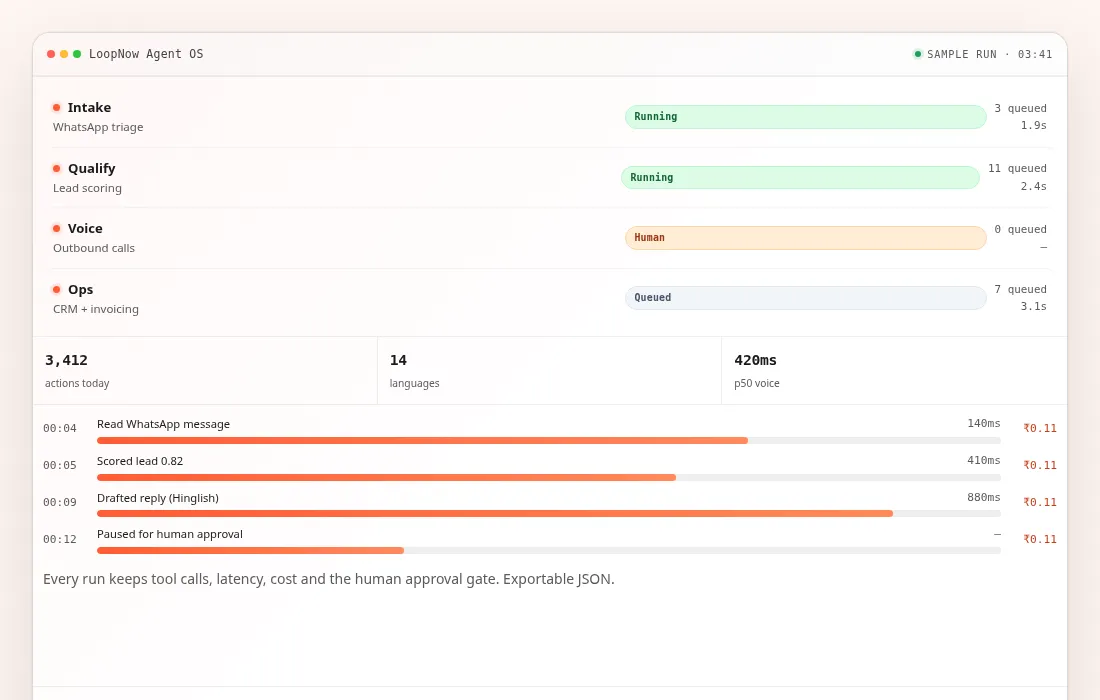
At the end of four weeks the team reviews meetings held, cost per meeting with seller time included, CRM completeness and inbox placement. It also reads twenty reply threads end to end, because a metric cannot tell you whether the agent sounded like a person who had read the company’s website. The decision to continue is based on those five things, and the decision to expand to a second segment waits until the first is stable.
Frequently asked questions
Will an AI SDR replace our sales development team?
Not wholesale, and a pilot that assumes it will usually fails for organisational reasons before technical ones. The agent is strongest at research, first touch, follow-up and scheduling, and weakest at reading a delicate political situation inside an account. Most teams keep humans on strategy and late-stage conversations.
How is this different from an email sequencer?
A sequencer sends a predefined series and stops at a reply. An AI SDR reads the reply, classifies the intent, answers routine questions from an approved facts file, books the meeting and writes the outcome to the CRM. The loop and the write-back are the difference, and they are also what make it harder to evaluate.
Can it message people on WhatsApp?
Only with opt-in, and outside a twenty-four hour service window only with an approved template in the correct category. Marketing and utility templates carry different rates and different rules. Treating WhatsApp like email will damage the number’s quality rating, which affects every conversation on that number, not just the campaign.
What about cold calling in India?
Outbound voice has to respect do-not-disturb status and regulator-set calling hours, and a WhatsApp opt-in does not authorise a call. Numbers should be scrubbed before dialling, and the campaign type, promotional or service, should be recorded. An agent that ignores this produces complaints that affect the whole business number.
How is fit scored?
With a weighted model over segment, size, geography, technology signals and trigger events, and with the reasons exposed per account. The weights should come from the sales team’s own closed-won data, not a vendor default. A score that cannot be explained will be ignored, and an ignored score is worse than no scoring at all.
What should a pilot measure?
Meetings held per thousand contacts approached, cost per meeting with human time included, positive reply rate against delivered, CRM completeness and inbox placement. Register the success test before the pilot starts, and read a sample of threads by hand. Volume and open rate are not success measures.
How does DPDP affect outbound?
Personal data needs a lawful purpose, notice and, for marketing, a consent basis you can evidence. Buying a list does not create one. Keep provenance per record, honour opt-outs at send time, and make erasure possible across the CRM, the sequences and the agent’s memory. LoopNow acts as a processor for customer marketing data.
How much does it cost?
On LoopNow the agent is part of a plan rather than a separate per-seat fee. Starter is ₹2,999 a month, Growth ₹7,999 and Scale ₹24,999, all exclusive of 18% GST, with published overage for email, WhatsApp, voice and AI tokens. A spend cap is on by default so a runaway sequence cannot produce an unbounded bill.
How long before it produces meetings?
The first sequences can send within a week if the list and consent basis are ready, but meetings depend on the segment and the offer, and no honest vendor can promise a timeline. Set the review at thirty days with a pre-registered test, and treat the first two weeks as a data-quality exercise rather than a revenue exercise.